

Doing everything “right” but the scale won’t budge? Discover the 10 most common fat loss mistakes — backed by research — and exactly how to fix each one.
You’re tracking your food. You’re hitting the gym. You’re trying so hard. And yet the scale has barely moved in weeks. Before you blame your metabolism or your genetics, it’s worth knowing something the research makes clear: most stalled fat loss isn’t a mystery of biology — it’s a handful of specific, fixable mistakes, quietly compounding on each other.
Here are the ten most common ones, what the science actually says about each, and exactly how to fix them.
1. Crash Dieting With an Extremely Low Calorie Intake
Cutting calories dramatically feels like the fastest path to results, but it tends to backfire. Pushing intake very low — generally below around 1,200 calories a day — tends to suppress your spontaneous daily movement (known as NEAT, or non-exercise activity thermogenesis) and lower your resting metabolic rate, which keeps a stall in place rather than solving it.
The fix: Aim for a moderate, sustainable deficit rather than the most aggressive one you can tolerate. Eating enough to preserve training quality and lean mass isn’t a compromise — it’s the actual strategy that works long-term.
2. Not Eating Enough Protein
This is one of the most consistently under-addressed mistakes in fat loss. When you’re in a calorie deficit, your body’s demand for amino acids actually rises, since it’s trying to preserve muscle tissue while pulling energy from fat stores. Falling short here means you risk losing meaningful muscle alongside fat — a much worse trade-off for your long-term physique and metabolism.
Research consistently points to 1.6 to 2.2 grams of protein per kilogram of body weight per day as the range that best preserves lean mass during a deficit, with some researchers suggesting even higher intakes (up to roughly 2.4 g/kg) specifically for very lean individuals trying to maximize fat loss while protecting muscle. Distributing this across meals matters too — research suggests 20 to 40 grams of protein per meal maximizes muscle protein synthesis better than front- or back-loading your intake.
The fix: Calculate your target using your body weight in kilograms, and spread it across 3–4 meals rather than concentrating it at dinner.
3. Not Tracking Anything — or Tracking Inconsistently
It’s tempting to “eyeball it” once you feel like you know your diet well. But consistent self-monitoring is one of the most reliable predictors of long-term weight-loss success in the research literature. The reason isn’t really about discipline — it’s that the act of recording surfaces hidden calories from drinks, dressings, and snacks that quietly erase a deficit you thought you were maintaining.
The fix: Track consistently, even imperfectly, especially during the first several weeks of any new plan. The goal isn’t obsessive precision — it’s catching the blind spots that always sneak in once you stop paying close attention.
4. Judging Progress by the Scale Alone, Day to Day
Daily weight fluctuates for reasons that have nothing to do with fat loss — water retention, sodium intake, hormonal cycles, even how much you slept. Reacting emotionally to a single bad number is one of the most common ways people convince themselves a plan “isn’t working” when it actually is.
The fix: Look at 7-day rolling averages instead of single-day readings. Weekly trends reveal the real signal; daily numbers are mostly noise.
5. Underestimating How Fast Metabolic Adaptation Happens
Many people assume a stall means something has gone wrong. Often, it’s just biology working exactly as expected. Within roughly 4 to 8 weeks of sustained caloric deficit, the body activates metabolic adaptation, reducing NEAT by an estimated 100 to 400 calories per day and tightening hunger-hormone regulation — all without you doing anything differently. Without an evidence-based adjustment, a striking 40 to 60% of dieters stall somewhere between month two and month four.
The fix: Expect this adaptation in advance rather than being blindsided by it. When progress stalls around this window, the answer usually isn’t “try harder” — it’s recalibrating intake, activity, or both based on what your body is actually doing now.
6. Relying on Cardio Alone Instead of Strength Training
Cardio burns calories in the moment, but it doesn’t do much to protect or build the muscle that keeps your metabolism running efficiently over the long haul. Current research-backed guidance suggests strength training 3 to 4 times per week, combined with consistent daily walking (roughly 8,000–10,000 steps), outperforms cardio alone for breaking through a stalled fat-loss phase. Moderate cardio can still supplement this approach — just not replace it.
The fix: Prioritize resistance training as your foundation, and treat cardio as a helpful addition rather than your primary fat-loss tool. We’ve covered the deeper mechanics of why mobility and strength training reinforce each other in our guide on building mobility for strength training, which becomes increasingly relevant as your training volume increases during a fat-loss phase.
7. Treating Sleep as Optional During a Cut
This mistake is more costly than most people realize, and the evidence here is specific. A well-known study comparing two groups on matched calorie deficits found that the group sleeping only 5.5 hours per night lost 60% more lean, fat-free mass than the group sleeping 8.5 hours — even though both groups lost a similar amount of total weight. In other words, poor sleep during a cut doesn’t just slow progress; it actively shifts what kind of weight you lose, trading muscle for fat at a significantly worse ratio. For the full hormonal picture, our piece on how sleep affects muscle growth and fat loss breaks down exactly why this happens.
The fix: Treat 7 hours as a non-negotiable floor during a fat-loss phase specifically, not just a nice-to-have you can sacrifice when life gets busy.
8. Quitting Entirely After One “Bad” Day
A single off-plan meal or missed workout has almost no measurable impact on fat loss. The damage almost always comes from what happens next — the all-or-nothing spiral where one slip gets reframed as total failure, triggering days or weeks of abandoned effort. If this pattern sounds familiar, our deep dive on the all-or-nothing mindset walks through exactly why this happens and how to interrupt it before it derails an otherwise solid plan.
The fix: Use the “never miss twice” rule. One off day is just a data point; what matters is what you do at your very next opportunity.
9. Treating Every Plateau the Same Way
A common mistake isn’t making a mistake at all — it’s applying the same generic advice (“eat less, move more”) to every stall, regardless of cause. A plateau driven by metabolic adaptation needs a different fix than one driven by inconsistent tracking, which needs a different fix than one driven by poor sleep or under-recovery.
The fix: Before changing anything, try to identify the actual bottleneck — Is it intake? Movement? Recovery? Tracking accuracy? — rather than reflexively cutting calories further, which is rarely the right first move and can worsen metabolic adaptation instead of resolving it.
10. Ignoring Refeed Days and Diet Breaks Entirely
For lean dieters especially, continuous, uninterrupted dieting for months on end can work against you. Research on planned refeed days — typically one to two days per week eaten at maintenance calories with higher carbohydrates — shows measurable benefits for leptin levels and training performance. These strategies are most useful for leaner individuals further into a diet; they’re less critical early on or for those with higher starting body fat levels, but dismissing them outright ignores a genuinely useful tool.
The fix: If you’re several weeks into a sustained deficit and getting leaner, consider planned refeeds or periodic diet breaks rather than assuming more restriction is always the answer.
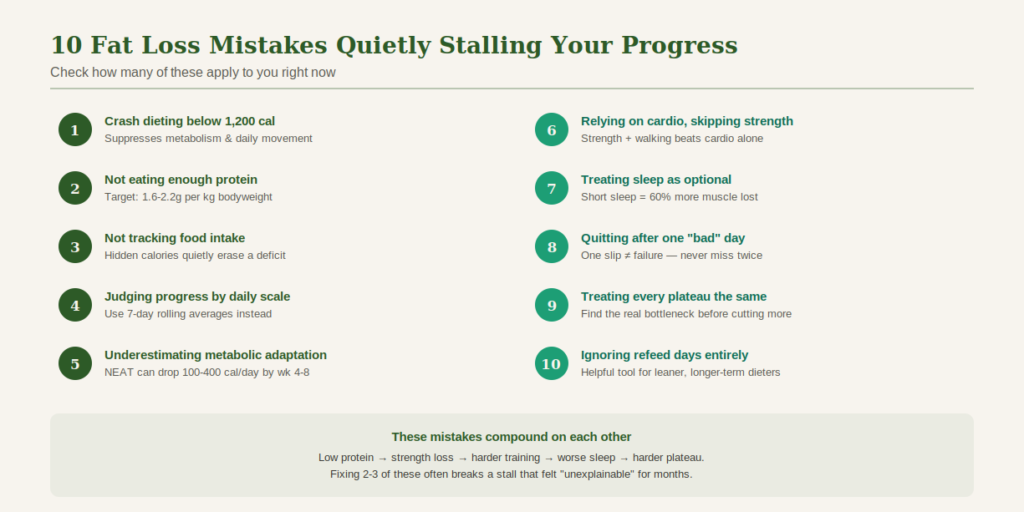
How These Mistakes Compound on Each Other
Here’s what makes this list particularly important: these mistakes rarely show up in isolation. Someone undereating protein is also more likely to lose strength, which makes consistent training harder, which often coincides with worse sleep from frustration or stress, which then makes an already-difficult plateau even harder to break. Fixing one piece in isolation sometimes isn’t enough if two or three others are quietly working against you at the same time.
This is also exactly why building sustainable, structured systems matters more than relying on willpower to manage all ten of these variables simultaneously, day after day, for months.
The Bottom Line
Long-term success in weight management is genuinely difficult — most evidence suggests only about 10 to 20% of people maintain significant weight loss over the long term — but that statistic reflects how often these exact mistakes go uncorrected, not some fixed ceiling on what’s achievable. Nearly every item on this list is fully within your control: how much protein you eat, how you track, how you interpret the scale, how much you sleep, and how you respond when a plateau hits or a bad day happens.
Fix even two or three of these, and you’ll likely notice the difference within weeks. Fix most of them, and the “mysterious” stall that’s been frustrating you for months often turns out to have a very findable explanation after all.
FAQs: Fat Loss Mistakes
Q: What’s the most common reason fat loss stalls even when I’m trying hard?
A: Within 4 to 8 weeks of sustained calorie restriction, the body activates metabolic adaptation, lowering daily movement and tightening hunger hormones. This is a normal, expected biological response rather than a sign that something has gone wrong with your effort.
Q: Is eating very few calories the fastest way to lose fat?
A: Not usually. Pushing intake below roughly 1,200 calories a day tends to suppress your resting metabolic rate and spontaneous daily movement, which can stall progress rather than accelerate it. A moderate, sustainable deficit generally outperforms an extreme one over time.
Q: How much protein do I actually need while trying to lose fat?
A: Most research points to 1.6 to 2.2 grams of protein per kilogram of body weight per day as the range that best preserves muscle during a calorie deficit, with leaner individuals sometimes benefiting from slightly higher intakes toward the upper end of that range.
Q: Should I weigh myself every day while trying to lose fat?
A: Daily weigh-ins can be useful for data, but the actual signal comes from your 7-day rolling average, not any single day’s number. Day-to-day weight fluctuates due to water, sodium, and hormones, which has little to do with actual fat loss.
Q: Does one bad day of eating really ruin fat loss progress?
A: No, a single off-plan day has minimal measurable impact on fat loss on its own. The real damage usually comes from treating that one day as a reason to abandon the plan entirely for days or weeks afterward.
Q: Is cardio or strength training better for breaking a fat loss plateau?
A: Current research suggests strength training several times per week, combined with consistent daily walking, tends to outperform cardio alone for breaking a stalled fat-loss phase, primarily because it helps preserve the muscle mass that supports your metabolism.
Q: What should I do differently if I hit a weight loss plateau?
A: Rather than immediately cutting calories further, it helps to identify the actual cause first, whether that’s inconsistent tracking, insufficient protein, poor sleep, or genuine metabolic adaptation, and address that specific bottleneck rather than applying the same generic advice to every stall.