On this page
- Sleep Isn't Rest. It's Active Repair Work.
- The Hormonal Engine Behind Muscle Growth — and What Happens When Sleep Is Cut
- Why Cortisol Is the Hidden Variable in Sleep-Deprived Training
- What Sleep Loss Does Specifically to Fat Loss
- How Much Sleep Do You Actually Need?
- What This Means for Your Training and Diet
- Practical Ways to Protect Your Sleep for Better Results
- The Bottom Line
- FAQs: Sleep, Muscle Growth, and Fat Loss
Training hard but sleeping less? Discover how sleep directly impacts muscle recovery, fat loss, and hormone balance.
You're hitting every session. Your protein intake is on point. Your program is solid. And yet progress feels frustratingly slow. Before you blame your genetics or your program, there's a far more common culprit hiding in plain sight: how much you actually slept last night.
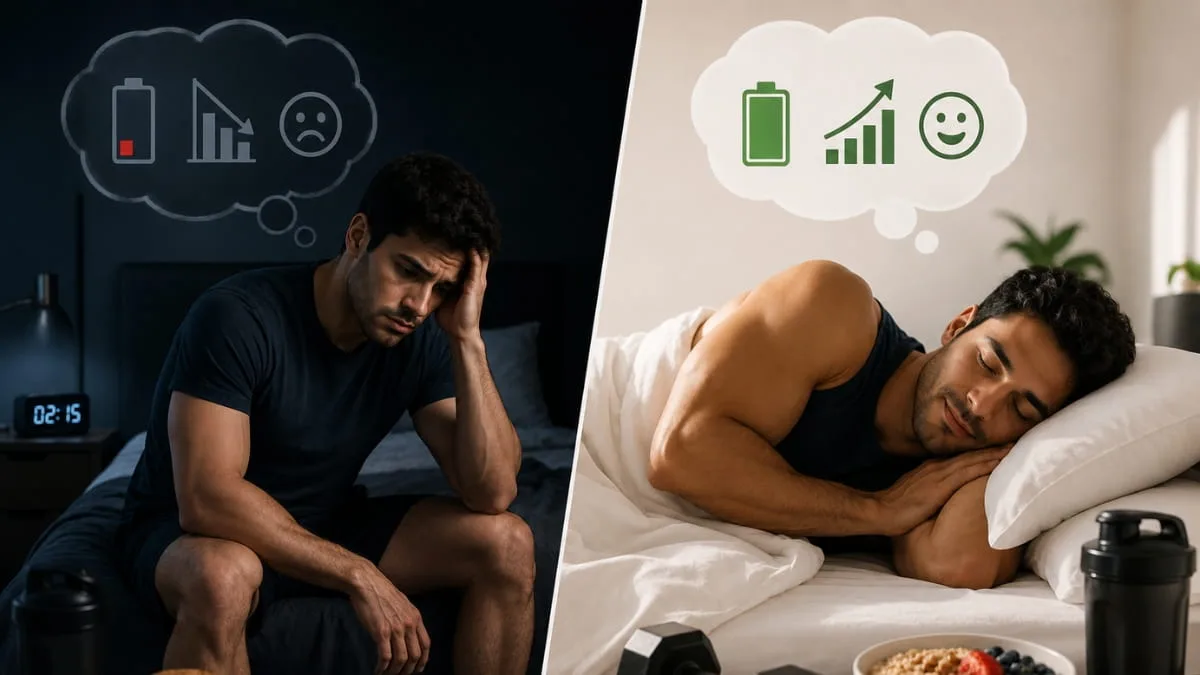
Sleep isn't passive downtime between workouts. It's an active, hormonally-driven biological process — and increasingly, the research shows it might be the single most underrated variable in body composition. Let's get into exactly what the science says, because it's more specific and more measurable than most people realize.
Sleep Isn't Rest. It's Active Repair Work.
For a long time, sleep was treated as the brain simply switching off. That picture has changed dramatically. A landmark 2025 study published in the journal Cell by researchers at UC Berkeley mapped the exact brain circuitry responsible for releasing growth hormone during sleep — finally explaining a mechanism scientists had observed for decades but never fully understood. The takeaway is striking: your brain actively uses deep sleep to flood the body with growth hormone, repairing muscle tissue, strengthening bone, and regulating metabolism, all while you're unconscious.
In other words, sleep isn't the absence of activity. It's when a huge portion of the actual rebuilding happens.
The Hormonal Engine Behind Muscle Growth — and What Happens When Sleep Is Cut
Two hormones do most of the heavy lifting for muscle growth and recovery: growth hormone (GH) and testosterone. Both are tightly synchronized to your sleep cycle, not just your training schedule.
Growth Hormone Peaks Specifically During Deep Sleep
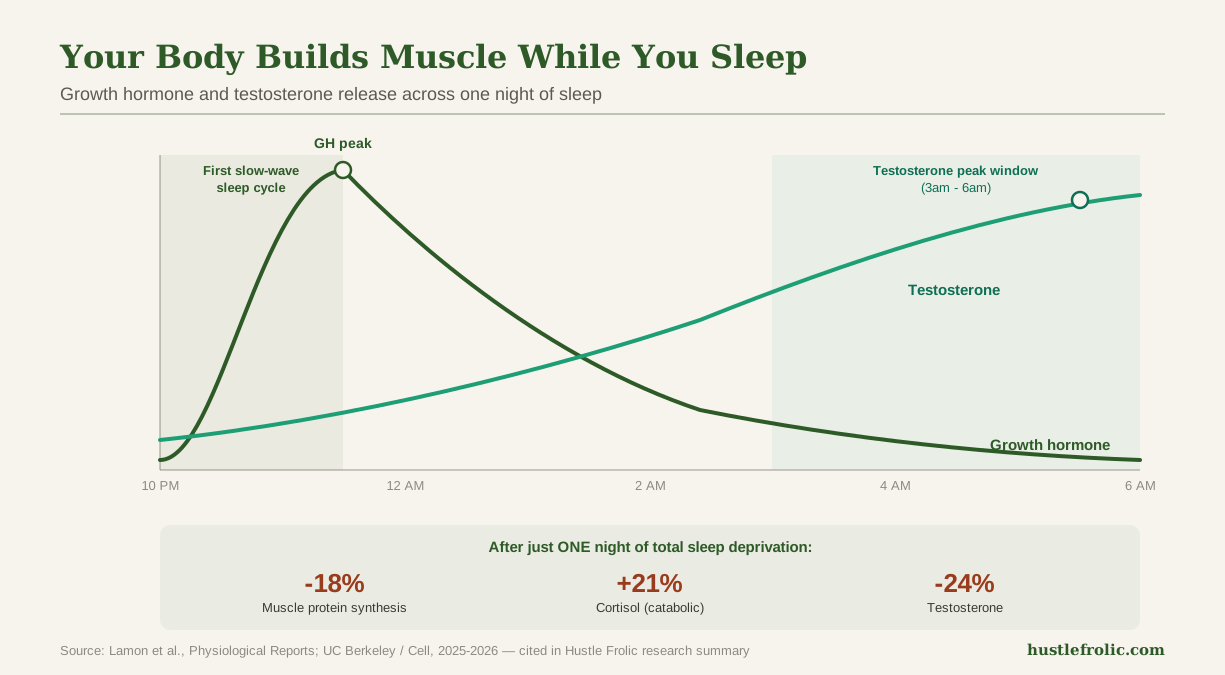
The largest single pulse of growth hormone release in a full 24-hour period happens during your first cycle of slow-wave sleep — typically within the first 90 minutes after falling asleep. This isn't a release that can simply be rescheduled later in the night. Cut that window short with a late bedtime, fragmented sleep, or a disrupted sleep cycle, and the release is blunted — not delayed.
Testosterone Follows the Same Overnight Rhythm
Testosterone rises through the night, peaking during the early morning hours of sleep, generally between 3 and 7 a.m. If you're consistently getting five or six hours of sleep, you're cutting your night short right as this peak is building — which means you're quite literally training and recovering on a lower testosterone environment than you would be with adequate sleep.
The Numbers From a Single Bad Night Are Striking
This isn't a vague, long-term association — it's been measured directly in controlled research. A randomized crossover study by Lamon and colleagues, published in Physiological Reports, found that just one night of total sleep deprivation in healthy young adults produced:
- An 18% reduction in skeletal muscle protein synthesis
- A 21% rise in cortisol (a catabolic, muscle-breakdown-promoting hormone)
- A 24% drop in testosterone the following morning
Read that again: one bad night of sleep, not weeks of chronic deprivation, was enough to measurably suppress the exact biological process responsible for building new muscle tissue.
Why Cortisol Is the Hidden Variable in Sleep-Deprived Training
Cortisol gets unfairly demonized in fitness culture, but the nuance matters here: cortisol itself isn't the enemy — chronically elevated cortisol from poor sleep is. Cortisol is a catabolic hormone, meaning it promotes the breakdown of tissue, including muscle, for energy. Normally, your cortisol rhythm dips at night, creating the recovery-friendly hormonal window where growth hormone and testosterone do their work.
Sleep deprivation disrupts this rhythm directly. As shown in the Lamon research above, even a single sleepless night raises cortisol significantly the next morning — meaning you're walking into your next training session in a more catabolic hormonal state than you'd otherwise be in, regardless of how well-designed your program is.
What Sleep Loss Does Specifically to Fat Loss
If you're in a calorie deficit trying to lose fat while preserving muscle, sleep matters even more — and the research here is some of the most directly applicable in all of exercise science.
You Lose More Muscle, Not More Fat, When Sleep Is Cut
A widely cited study by Nedeltcheva and colleagues, published in the Annals of Internal Medicine, placed dieters on matched calorie deficits and compared two groups: one sleeping 8.5 hours per night, the other restricted to 5.5 hours. Both groups lost a similar amount of total weight. But the sleep-restricted group lost 60% more lean, fat-free mass — meaning a much larger share of their total weight loss came from muscle rather than fat.
This is one of the clearest findings in the entire field: cutting sleep during a fat-loss phase doesn't just slow progress — it actively shifts what kind of weight you lose, trading muscle for fat at a significantly worse ratio.
The Appetite-Hormone Picture Is Real, But More Nuanced Than Commonly Claimed
You've probably heard that poor sleep "wrecks your hunger hormones" — specifically leptin (which signals fullness) and ghrelin (which drives hunger). Several well-known studies have found that sleep restriction lowers leptin and raises ghrelin, increasing hunger and snack intake. One controlled study found sleep restriction led to an increase of roughly 328 extra calories from snacks per day, primarily from carbohydrates.
That said, it's worth being accurate here: a more recent 2025 systematic review and meta-analysis pooling several randomized controlled trials found no statistically significant overall changes in leptin or ghrelin following short-term sleep deprivation, with considerable variability between studies. The honest takeaway is that the relationship between sleep and appetite hormones is real but more individually variable than older single studies suggested — while the muscle-loss findings from calorie-deficit research remain considerably more consistent and robust.
Energy Expenditure Also Takes a Hit
Beyond appetite, sleep-deprived individuals have also been shown to have measurably reduced total energy expenditure compared to well-rested individuals — meaning poor sleep can work against fat loss from both the intake side and the output side simultaneously.
How Much Sleep Do You Actually Need?
Based on the hormonal research above, most evidence points to 7 hours as the practical minimum for protecting the testosterone and growth hormone cycles that drive recovery. Below that threshold, the hormonal and performance costs become measurable rather than theoretical.
Interestingly, more isn't necessarily better past a certain point — research suggests limited additional benefit for most people above 9 hours. The real goal isn't maximizing hours in bed; it's hitting a consistent window, night after night, that allows your slow-wave sleep and early-morning hormone peaks to occur uninterrupted.
This consistency matters more than people expect. An irregular sleep schedule — even one that averages out to enough total hours — disrupts the timing of hormone release, because these systems are synchronized to your circadian rhythm, not just a raw hour count.
What This Means for Your Training and Diet
Putting the research together, here's how sleep fits into the bigger picture of building a fit body:
- Training creates the stimulus. Resistance training is what signals your body that muscle adaptation is needed.
- Nutrition supplies the building blocks. Adequate protein gives your body the raw material to rebuild.
- Sleep provides the environment where it actually happens. Without it, the hormonal conditions needed for recovery and adaptation are measurably impaired — even when training and nutrition are otherwise perfect.
This is also exactly why a structured, sustainable system matters more than chasing peak intensity in any single session. A consistent sleep schedule is, in many ways, just another habit-stacked system — one that protects the biological window where your training actually converts into results.
Practical Ways to Protect Your Sleep for Better Results
- Protect your first 90 minutes after lights-out. This is when the largest growth hormone pulse of the day occurs — avoid late-night disruptions, alarms, or screen use that delay falling asleep.
- Keep a consistent sleep and wake time. Anchoring your circadian rhythm matters more than chasing a perfect number of hours occasionally.
- Treat 7 hours as a floor, not a target to dip below "when busy." The hormonal cost of dropping under this threshold is measurable, not hypothetical.
- Prioritize recovery sleep after a bad night. Missed sleep suppresses growth hormone, but research shows that recovery sleep helps restore it — so don't compound one rough night with another.
- Be especially strict about sleep during a fat-loss phase. Since calorie deficits already create some catabolic pressure, inadequate sleep during a cut is precisely when the lean-mass cost is highest.
- Cool, dark, and quiet wins over occasional "extra" hours. Sleep quality and depth — not just duration — determines how much of that slow-wave, hormone-releasing sleep you actually get.
The Bottom Line
Sleep isn't a wellness afterthought you can sacrifice when life gets busy — it's a measurable, hormonally specific driver of whether your training and nutrition actually translate into muscle growth and fat loss. A single night of poor sleep can drop testosterone by nearly a quarter and cut muscle protein synthesis by almost a fifth. During a calorie deficit, inadequate sleep can mean losing far more muscle than necessary for the same amount of fat lost.
If your progress has stalled despite doing everything else right, sleep deserves to be the very first thing you investigate — not the last.
FAQs: Sleep, Muscle Growth, and Fat Loss
Q: How many hours of sleep do I need for muscle growth?
A: Most research points to roughly 7 hours as the practical minimum needed to protect the testosterone and growth hormone cycles tied to recovery. Going much below that threshold has measurable hormonal costs, while sleeping beyond 9 hours generally offers little additional benefit for most people.
Q: Can one bad night of sleep really affect muscle growth?
A: Yes. Controlled research has shown that a single night of total sleep deprivation can reduce muscle protein synthesis by around 18%, raise cortisol by about 21%, and lower testosterone by roughly 24% the following morning — measurable effects from just one night, not weeks of poor sleep.
Q: Does poor sleep make you lose muscle instead of fat during a diet?
A: It can. A well-known study comparing matched calorie deficits found that dieters sleeping only 5.5 hours per night lost 60% more lean, fat-free mass than those sleeping 8.5 hours, even though total weight loss was similar between groups.
Q: Does sleep deprivation actually increase hunger and appetite?
A: Many studies have found that sleep restriction lowers leptin and raises ghrelin, increasing hunger and snack intake. However, more recent meta-analyses show this effect is less consistent than once believed, suggesting real but individually variable effects on appetite hormones.
Q: When does growth hormone release the most during sleep?
A: The largest single pulse of growth hormone in a 24-hour period occurs during the first cycle of slow-wave sleep, typically within the first 90 minutes after falling asleep. Disrupting this early window blunts the release rather than simply delaying it to later in the night.
Q: Is sleep quality or sleep duration more important?
A: Both matter, but they serve different purposes. Duration determines whether you get enough total recovery time, while quality — particularly reaching slow-wave sleep — determines whether the hormonal release windows tied to muscle repair actually occur during that time.
Q: Can I make up for lost sleep with a nap?
A: Naps can help with alertness, but they don't fully replace the deep, slow-wave sleep cycles where growth hormone is released overnight. If you miss sleep, prioritizing a full night of recovery sleep as soon as possible is more effective than relying on naps alone.