
On this page
Stop relying on motivation. Learn how to build powerful fitness habits that create long-term transformation.
You've done it before. You start strong on a Monday, buy the right shoes, plan your meals for the week, maybe even tell a few people about your "new fitness journey." Three weeks later, the gym bag is back in the closet and you're telling yourself you'll restart next month.
If this sounds familiar, the problem isn't you. It's the model you've been using.
Most fitness advice is built on a single, flawed assumption: that motivation is the fuel for consistency. Feel inspired, go to the gym. Feel uninspired, skip it. The trouble is that motivation is not a stable resource. It's an emotion, and emotions fluctuate with sleep, stress, work deadlines, and a hundred other variables you don't control. Building a fitness routine on top of something this unreliable is like building a house on sand.
The good news is that the science of behavior change has matured considerably over the past decade, and it tells a very different story about what actually makes habits stick. This isn't about willpower or discipline in the way most people imagine those words. It's about understanding how the brain automates behavior, and then engineering your environment and routines to work with that process instead of against it.
Why "21 Days" Was Always a Myth
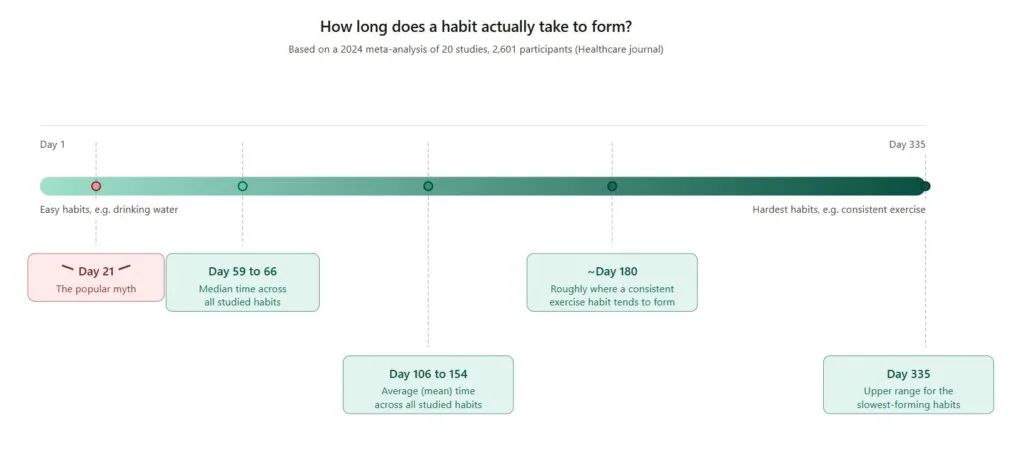
You've probably heard that it takes 21 days to form a habit. This number has been repeated so often it's treated as fact, but it has no real scientific basis — it traces back to a 1960 observation by a plastic surgeon about patients adjusting to new faces, not a controlled study on habit formation.
The actual research tells a more sobering, but ultimately more useful, story. A 2024 systematic review and meta-analysis published in the journal Healthcare examined 20 studies involving over 2,600 participants and looked specifically at health behaviors like exercise, hydration, and diet. The findings: the median time to form a habit ranged between 59 and 66 days, with the average ranging from 106 to 154 days. More strikingly, the full range across individuals stretched from just 4 days to as long as 335 days, depending on the behavior and the person.
Exercise specifically tends to sit at the difficult end of that spectrum. Compared to simpler behaviors like handwashing, which can become automatic in a few weeks, researchers have found that developing a consistent exercise habit takes roughly half a year on average. That's not a discouraging fact — it's a recalibration. If you've been judging your "failed" attempts at fitness against a 21-day timeline, you were never actually failing. You were just being measured against a number that was never real.
This matters because expectation directly affects persistence. The same review noted that helping people understand habit formation as a gradual process, rather than something that should click into place quickly, helps them stay consistent instead of giving up when results don't appear on schedule. Once you know that six months of inconsistent effort is closer to "on track" than "failing," the way you respond to a missed Tuesday workout changes completely.
The Real Reason Motivation Fails
Motivation has two distinct components, and most people only ever experience one of them. There's participation motivation — the burst of energy that gets you to sign up for a gym membership or start a new program — and there's adherence motivation, the much quieter, more persistent drive that keeps you showing up in week eleven when nothing feels exciting anymore. Roughly half of people who begin a regular exercise program drop out within the first six months, and the research is clear that this happens because they had the first kind of motivation but never developed the second.
There's a biological reason the "just push through with willpower" approach collapses by evening. Willpower draws on a limited daily resource tied to glucose and cognitive load. Research on self-control pioneered by psychologist Roy Baumeister demonstrated that willpower depletes throughout the day as you make decisions, resist temptations, and manage stress — which is exactly why a 7 a.m. workout often feels far more doable than the same workout planned for 8 p.m., after a full day of meetings has already drawn down your reserves. This isn't a character flaw. It's biology. If you've ever wondered why your evening intentions consistently lose to your evening exhaustion, this is the mechanism.
This is also why the people who exercise consistently for years rarely describe it as a daily act of willpower. They've shifted the behavior out of the "decision" category entirely. As one framework puts it plainly: a system "doesn't require motivation, it requires setup." Once a routine is genuinely automated — scheduled, prepared for, and expected — you stop deciding whether to work out and simply do it, the same way you don't deliberate over brushing your teeth.
What Actually Builds a Habit: The Mechanics
If motivation isn't the lever, what is? Behavioral science points to a few well-tested mechanisms. None of them are exciting. All of them work.
1. Anchor new habits to existing ones (habit stacking)
Your brain doesn't build new behaviors from nothing — it attaches them to existing neural pathways that are already well-worn. This is the principle behind a technique researcher BJ Fogg developed and author James Clear later popularized as "habit stacking": you identify a behavior you already do reliably every day, and attach your new habit directly to it.
The formula is simple: After [current habit], I will [new habit]. "After I change out of my work clothes, I will put on my gym clothes." "After I finish my morning coffee, I will do ten minutes of mobility work." The specificity matters enormously here. Vague anchors like "after work" don't work as well as concrete, physical triggers like "after I put my plate in the sink" — because the brain needs an unambiguous cue, not a general window of time.
2. Use implementation intentions, not vague goals
"I'll try to work out more" is a wish, not a plan. The behavioral science term for what actually works is an implementation intention — a specific if-then statement that removes the need for in-the-moment decision-making. Research has found that if-then plans, such as "If it's Monday at 6 PM, then I go to the gym," can roughly double exercise rates compared with goal-setting alone.
A simple way to build one: I will [action] at [time] in [location]. "I will strength train for 45 minutes at 7 a.m. at my gym." When motivation is low — and it will be, regularly — the decision has already been made. You're not negotiating with yourself; you're just executing a plan you committed to in a calmer moment.
This effect has been studied directly in exercise contexts. A controlled trial on physical activity habit formation found that implementation intentions produced measurable, sustained increases in activity levels, even after researchers stopped checking in with participants — though the effect was notably stronger when people's actual desire to exercise was already reasonably high, which is a useful reminder that the technique works best alongside genuine intent, not as a substitute for it.
3. Build identity, not just outcomes
Most people set fitness goals around outcomes: lose eight kilograms, fit into old jeans, run a 10K. These goals aren't useless, but research on behavior change increasingly points to a more durable driver sitting underneath them: identity.
A 2024 study published in the Journal of Personality and Social Psychology found that framing a habit in terms of identity — "I am someone who trains four times a week" — rather than outcome — "I want to lose weight" — increased adherence by 32%. The mechanism is straightforward: outcome goals are conditional and easy to abandon once results plateau or life gets busy. Identity-based habits are self-reinforcing. When you miss a session, you experience it as a minor deviation from who you are, not proof that the whole project has failed — and that distinction is often what separates a two-week relapse from a permanent one.
4. Design your environment before you trust your discipline
The most consistently underestimated factor in habit formation is environment. People with strong self-control aren't necessarily resisting more temptation moment to moment — research suggests they're simply spending less time in situations where temptation exists in the first place. The same logic applies in reverse to fitness: if your gym is a 40-minute drive away, or your running shoes are buried in a closet, you are negotiating with friction every single day, and friction wins more often than discipline does.
Practical environment design looks unglamorous: clothes laid out the night before, a gym bag that lives in the car, a home setup for the days you can't make it out. None of this requires motivation. It just requires removing the decision points where motivation would otherwise be needed.
5. Track consistency, not perfection
Tracking has a measurable effect on adherence — one analysis found habit tracking increased adherence rates by roughly 23%, with the largest gains showing up in the first month, when the behavior is least automatic and most fragile. But what you track matters. Tracking workout completion ("did I show up") builds consistency. Tracking scale weight daily tends to do the opposite, because it ties your sense of progress to a number that fluctuates for reasons that have nothing to do with whether you trained well that week.
Morning, Self-Selected, and Enjoyable: What the Data Says About Habit Strength
A few specific findings from the research are worth calling out because they run counter to common fitness culture advice.
Self-chosen habits stick better than prescribed ones. Across the studies reviewed in the 2024 meta-analysis, self-selected habits and morning-based routines generally showed greater habit strength than those imposed externally or scheduled later in the day. This has a direct implication for how you should choose your training time and your training method: the "optimal" program on paper is worthless if you didn't choose it and won't sustain it.
Enjoyment is not optional, it's structural. The same review identified enjoyment as a critical component of maintaining healthy behaviors over time — not a nice-to-have, but one of the actual mechanisms that determines whether a habit survives. If you hate running, building your entire cardio habit around running is setting yourself up against the data, not with it.
Frequency and consistency of timing matter more than intensity. Repeating a behavior regularly, in a stable context, is what converts a deliberate action into an automatic one. A workout you do four times a week at a roughly similar time will become habitual faster than a more "perfect" workout you do sporadically.
What This Looks Like in Practice
Pulling this together, a sustainable approach to building a fitness habit looks less like a 30-day transformation challenge and more like a slow, deliberate system:
- Choose a training time and method you can defend on a bad day, not just a good one.
- Build one implementation intention — a specific time, place, and action — rather than a general intention to "be more active."
- Anchor the new habit to something you already do without thinking.
- Track whether you showed up, not just what the scale says.
- Expect the behavior to feel effortful for two to six months. That's not a sign of failure — it's the documented timeline.
- Let your identity shift before you expect your results to fully show up. The belief tends to lead, not follow.
None of this is dramatic. That's the point. The people who train consistently for years aren't relying on a deeper well of motivation than everyone else — they've simply stopped needing it, because the behavior has been engineered to run on structure instead.
Motivation will get you to day one. It's the system you build underneath it that gets you to day five hundred.