On this page
- First: A Little Post-Workout Knee Ache Is Often Completely Normal
- The Most Common Causes of Knee Pain After Working Out
- Using Pain Location to Narrow Down the Cause
- Is Your Squat Form Actually the Problem?
- Safe Solutions: What Actually Helps
- When to See a Doctor Instead of Self-Treating
- The Bottom Line
- FAQs: Knee Pain After Workout
Knees aching after every leg day or run? Discover the most common causes of post-workout knee pain, how to tell them apart, and safe ways to keep training without making it worse.
You finish your workout feeling accomplished, and a few hours later, your knee starts complaining. Is it just a normal part of training hard, or a sign you've done real damage? This is one of the most common questions in all of fitness — and also one of the most commonly mishandled, because people tend to swing to one of two extremes: ignoring pain that needed attention, or giving up an activity that wasn't actually the problem.
Let's walk through what's actually going on when your knees hurt after exercise, how to figure out which of the common causes applies to you, and what to do about it without unnecessarily abandoning your training.
First: A Little Post-Workout Knee Ache Is Often Completely Normal
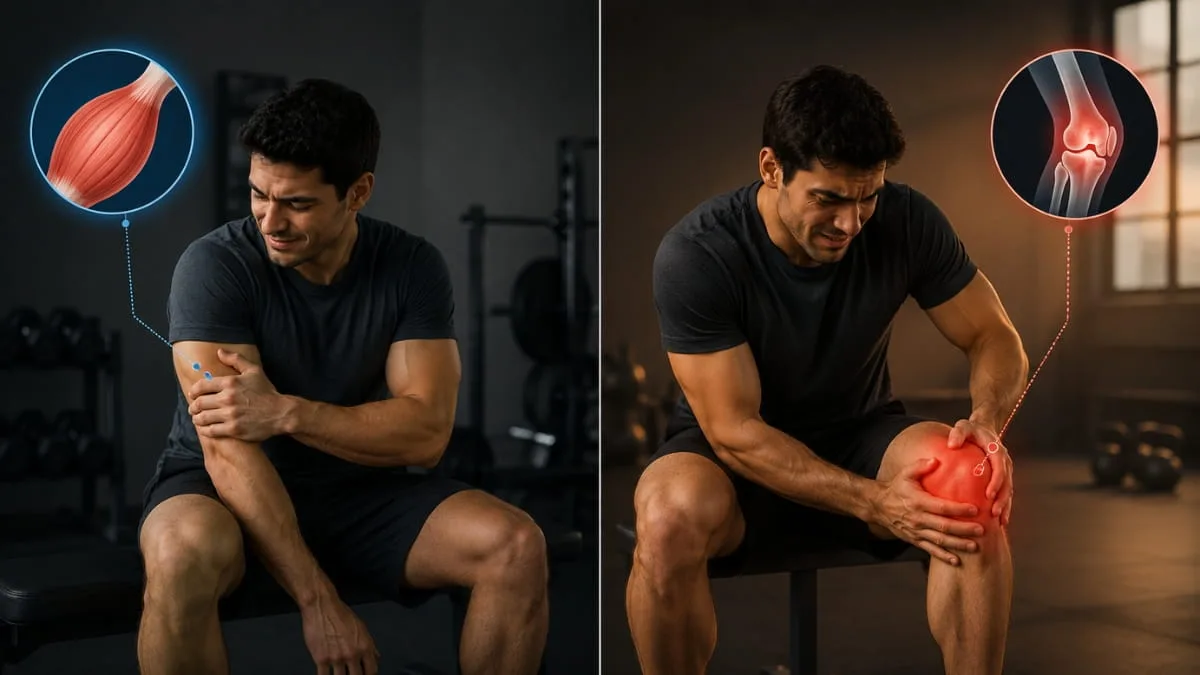
Before assuming the worst, it's worth knowing that mild, short-lived knee discomfort after a workout is genuinely common and not automatically a red flag. According to physical therapists at Hinge Health, one of the most frequent causes of post-workout knee pain is simply DOMS — delayed onset muscle soreness. While your knee itself isn't a muscle, several major muscle groups attach via tendons directly into the knee joint, so soreness in those surrounding muscles is often felt as soreness in the knee itself.
This kind of discomfort typically follows a predictable pattern: it builds 24 to 48 hours after training, feels like a dull, generalized ache rather than a sharp or specific pain, and fades on its own within a few days. If that sounds like what you're experiencing, you're very likely dealing with a normal training response rather than an injury.
The Most Common Causes of Knee Pain After Working Out
Beyond ordinary soreness, a handful of specific conditions account for the vast majority of post-workout knee pain. Here's how to recognize each one.
Patellofemoral Pain Syndrome ("Runner's Knee")
This is one of the most frequently diagnosed sources of knee pain in active people. According to the Hospital for Special Surgery, it occurs when the kneecap doesn't track smoothly within its groove as the knee bends, putting uneven pressure on the cartilage underneath. The pain is typically felt at the front of the knee, around or behind the kneecap, and tends to worsen with squatting, running, climbing stairs, or sitting for long periods with the knee bent.
Patellar Tendinitis ("Jumper's Knee")
This involves inflammation of the tendon connecting your kneecap to your shinbone, and as the nickname suggests, it's especially common after repeated jumping or landing on hard surfaces. The pain is usually felt as a sharp or aching sensation just below the kneecap, often worse when jumping, squatting deeply, or going down stairs.
Iliotibial Band Syndrome (ITBS)
The IT band is a thick band of connective tissue running from your hip down the outside of your thigh to your shinbone. When it becomes irritated, it can rub against the outer part of the knee with repetitive bending, which is why ITBS shows up so often in runners and cyclists. The telltale sign is pain specifically on the outside of the knee, which can sometimes radiate up toward the hip.
Knee Bursitis
Small fluid-filled sacs called bursae cushion your knee joint, and they can become irritated and inflamed from overuse, repeated kneeling, or direct impact. According to Tarabichi Joint Care, this typically causes localized swelling and pain, most often at the front of the knee over or just below the kneecap.
Doing Too Much, Too Soon
Sometimes the cause isn't a specific diagnosis at all — it's simply progression that outpaced your knee's readiness. According to physical therapists at Hinge Health, common examples include jumping from 25 to 50 pounds on a leg press, doubling your usual squat reps, or suddenly running a hilly route instead of a flat one. A widely used, sensible guideline here is the 10% rule: increasing weekly training volume by no more than roughly 10% at a time, giving your joints and connective tissue time to adapt alongside your muscles.
Chondromalacia Patella
This refers to softening of the cartilage on the underside of the kneecap, and it's a common cause of squat-related knee pain in younger, otherwise healthy people. It typically produces a dull, achy pain at the front of the knee along with a grinding or grating sensation during squats — generally without the sharp, sudden quality of an acute injury.
Meniscus Involvement
Squatting and twisting movements load the meniscus significantly, and a tear here can also present as post-workout knee pain — particularly along the sides or back of the knee, sometimes with a catching or locking sensation. If you suspect this might be the cause, our detailed guide on the meniscus tear recovery timeline covers what to expect if this turns out to be the diagnosis.
Using Pain Location to Narrow Down the Cause
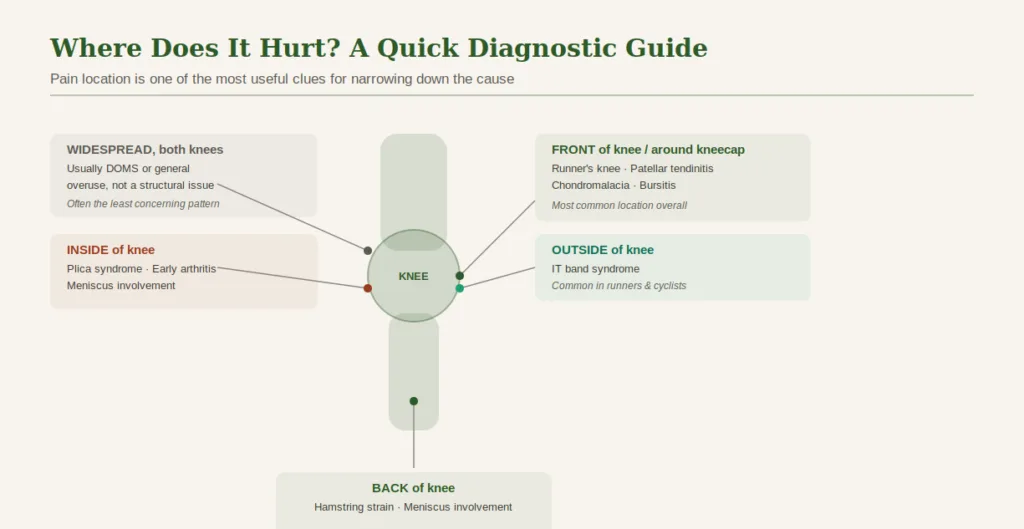
One of the most useful diagnostic shortcuts is simply paying attention to where the pain shows up:
| Where it hurts | Most likely causes |
|---|---|
| Front of the knee, around the kneecap | Runner's knee, patellar tendinitis, chondromalacia, bursitis |
| Outside of the knee | IT band syndrome |
| Inside of the knee | Plica syndrome, early-stage arthritis, meniscus involvement |
| Back of the knee | Hamstring strain, meniscus involvement |
| Widespread, dull, both knees evenly | Often DOMS or general overuse rather than a specific structural issue |
This isn't a substitute for a proper diagnosis, but it's a genuinely useful starting point for understanding what you might be dealing with.
Is Your Squat Form Actually the Problem?
Technique gets blamed for a lot of knee pain, and sometimes fairly — but it's also more nuanced than the fitness-culture version of this advice suggests.
What does matter: According to physical therapist Heather Jeffcoat, two common technique issues do increase load on the knee: letting your knees cave inward during a squat (valgus collapse), and failing to send your hips back, which shifts too much pressure onto the knee joint rather than distributing it through the hips and glutes. Strengthening the glutes and hip abductors — through exercises like glute bridges, banded lateral walks, and single-leg work — directly addresses both issues.
What's more myth than fact: The old warning that your "knees should never go past your toes" is largely outdated. According to physical therapists at Hinge Health, your knees naturally travel past your toes during everyday movements like walking down stairs, and doing so during a squat isn't inherently damaging — it simply means your knees are working a bit harder, which isn't automatically a problem. Similarly, if you've always squatted with a slightly knock-kneed pattern without any issues, that alone usually isn't worth aggressively "correcting."
The practical takeaway: focus on the things that genuinely matter — hip-dominant mechanics, controlled depth, and adequate glute strength — rather than chasing a rigid, "perfect" squat aesthetic.
Safe Solutions: What Actually Helps
Start With Relative Rest, Not Total Rest
For the vast majority of overuse-related knee pain, the goal isn't to stop all activity — it's to modify it. According to Hospital for Special Surgery, reducing squat depth to stop before pain begins, icing the area for 15 to 20 minutes after activity, and gradually building volume back up using something like the 10% rule resolves a large share of cases without needing imaging or surgery.
Strengthen the Muscles That Actually Support the Knee
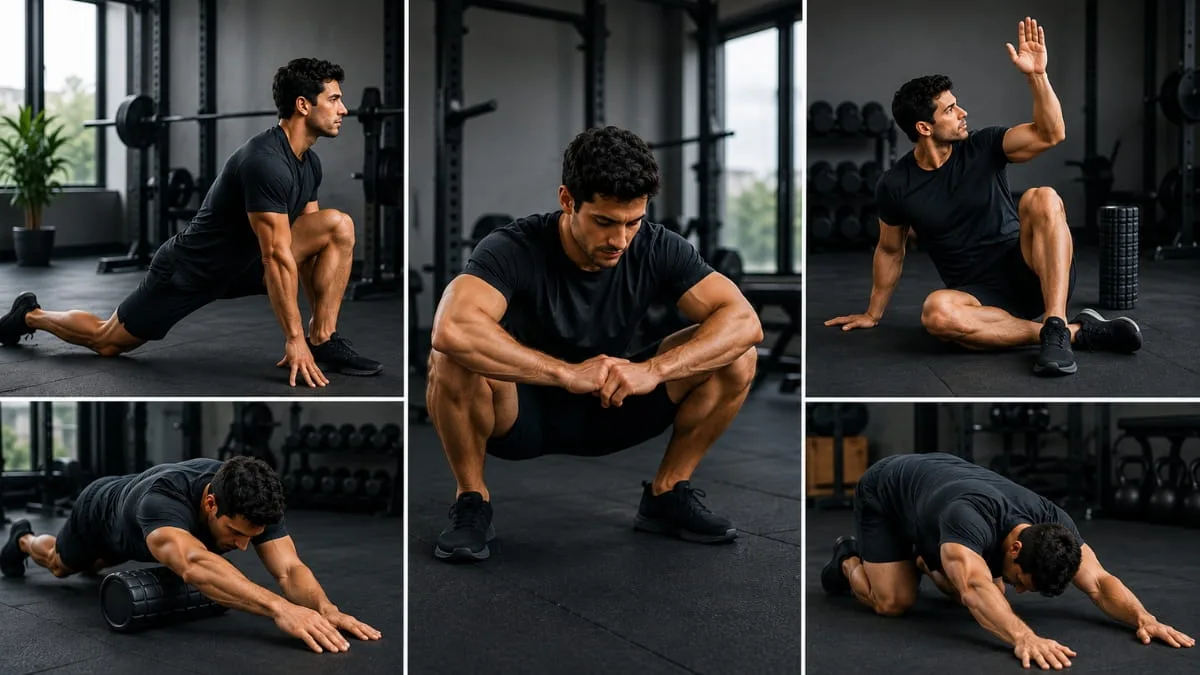
Across nearly every cause listed above, the supporting strategy is largely the same: build strength in the quadriceps, glutes, and hip stabilizers. Weakness in these areas is a common thread behind runner's knee, patellofemoral pain, and poor squat mechanics alike. Useful exercises include glute bridges, step-ups, split squats, and controlled, partial-range squats that stay above the depth where pain begins.
Choose the Right Type of Exercise If You're Managing Arthritis-Related Pain
If your knee pain is linked to osteoarthritis rather than an acute issue, the most current research offers some genuinely reassuring guidance. A major 2025 review published in The BMJ, analyzing over 200 trials and more than 15,000 participants, found that aerobic exercise — activities like walking, cycling, and swimming — produced the greatest improvements in pain, mobility, and quality of life for people with knee osteoarthritis, while remaining a safe approach overall. Strength training and mind-body exercises still help, but work best layered alongside aerobic activity rather than replacing it.
Don't Avoid the Movement Entirely
It's tempting to eliminate squatting, running, or any movement that triggers discomfort — but according to physical therapists, this can backfire. Avoiding a movement entirely often just delays the strengthening that movement actually needs to become pain-free again, and can lead to compensations elsewhere, like bending through your back instead of your knees during daily tasks. The better approach, in most cases, is modifying the movement (reducing depth, load, or frequency) rather than eliminating it outright.
Apply the Same Patience You'd Apply to Any Recovery
Knee pain that responds to smart, gradual loading is exactly the kind of situation where an all-or-nothing mindset does real damage — either pushing through pain that needed modification, or abandoning training entirely over discomfort that just needed a smarter approach. The middle path, adjusting rather than quitting, is almost always the right one.
When to See a Doctor Instead of Self-Treating
Most post-workout knee pain resolves with the strategies above, but certain signs mean it's time to get a professional evaluation rather than waiting it out. According to the Sports Injury & Pain Management Clinic of NYC, you should see a doctor if you experience:
- Chronic pain lasting more than three months that isn't improving with home treatment
- A noticeable limited range of motion, especially if it involves swelling or a mechanical block (a sensation of something catching inside the joint)
- A popping or snapping sensation at the time the pain began
- Visible swelling, bruising, or instability — a knee that feels like it might give way
- Pain that's worsening rather than improving over consecutive sessions, instead of following a normal recovery curve
- Pain severe enough to disrupt sleep, walking, or basic daily activities
If any of these apply to you, the right move is a proper evaluation — not pushing through, and not giving up on training altogether, but getting an accurate diagnosis so you know exactly what you're dealing with.
The Bottom Line
Most knee pain after a workout falls into one of a few well-understood categories — ordinary soreness, an overuse pattern from progressing too fast, or one of a handful of common conditions like runner's knee, patellar tendinitis, or IT band syndrome. The location of the pain, how it responds to rest and activity, and whether it's improving or worsening over time are your best clues for figuring out which one you're dealing with.
In nearly every case, the solution isn't to stop moving — it's to train smarter: modify load and depth, strengthen the muscles that actually support the knee, progress gradually, and get a proper evaluation when the warning signs call for it. Your knees are built to handle a lot of work. They just need the chance to adapt to it at a pace they can actually keep up with.
FAQs: Knee Pain After Workout
Q: Is it normal for my knees to hurt a little after every workout?
A: Mild, dull soreness that builds over a day or two and fades within a few days is often just delayed onset muscle soreness from the muscles surrounding your knee, not a sign of injury. Sharp, localized, or worsening pain is a different story and deserves closer attention.
Q: Why do my knees hurt more after squats specifically than other exercises?
A: Squatting significantly increases the load on the kneecap and meniscus compared to activities like walking, since joint forces at deep knee flexion can reach several times your bodyweight. This makes squats a common trigger for patellofemoral and meniscus-related pain if your knees aren't yet conditioned for that load.
Q: Should I stop working out completely if my knees hurt?
A: Usually not. For most overuse-related knee pain, modifying your activity — reducing squat depth, lowering the weight, or cutting training volume — tends to work better than stopping entirely, since complete rest can delay the strengthening your knee actually needs.
Q: Does the location of my knee pain actually tell me what's wrong?
A: It's a genuinely useful clue. Pain at the front of the knee often points to issues like runner's knee or patellar tendinitis, pain on the outside often points to IT band syndrome, and pain on the inside or back of the knee can suggest meniscus involvement or a hamstring issue. It's not a full diagnosis, but it's a solid starting point.
Q: Is letting my knees go past my toes during a squat actually bad?
A: Not inherently. This is one of the more persistent fitness myths — your knees naturally move past your toes during everyday movements like descending stairs, and allowing this during a squat simply increases knee demand rather than causing automatic damage.
Q: What's the best type of exercise if my knee pain is related to arthritis?
A: Current research points to aerobic exercise — walking, cycling, and swimming — as the most effective option for reducing pain and improving mobility in knee osteoarthritis, ahead of other exercise types, while remaining a safe approach overall.
Q: How fast should I increase my training intensity to avoid knee pain?
A: A commonly used guideline is the 10% rule: increasing weekly training volume, whether that's distance, weight, or reps, by no more than roughly 10% at a time. This gives your joints and connective tissue time to adapt alongside your muscles.
Note: This article is for general informational purposes and isn't a substitute for professional medical advice. If you're experiencing persistent, worsening, or severe knee pain, please consult a doctor or physical therapist for a proper evaluation.