On this page
- Mobility Isn't the Same Thing as Flexibility
- Why Mobility Directly Limits Your Strength Numbers
- The Static Stretching Mistake Most Lifters Still Make
- The 5 Most Useful Mobility Tools for Strength Training
- Building Mobility Into Your Training Week
- A Quick Self-Check: Where Is Your Mobility Actually Limited?
- The Bottom Line
- FAQs: Mobility for Strength Training
Tight hips, stiff shoulders, and a squat that just won't go deep enough? Discover how mobility training directly improves your strength, lifts, and injury resilience.
You can bench press your bodyweight but can't comfortably sit in a deep squat. You can deadlift heavy but your shoulders feel like rusted hinges during overhead presses. If this sounds familiar, you're not weak — you're likely dealing with a mobility gap, and it's quietly capping how much strength you can actually express in the gym.
Mobility isn't a separate, optional category of fitness reserved for yogis. For anyone serious about strength training, it's foundational infrastructure. Let's break down exactly what mobility is, why it matters for your lifts, and how to build it without wasting time on the wrong approach.
Mobility Isn't the Same Thing as Flexibility
Before going further, it's worth clearing up a common mix-up. Flexibility is the passive range of motion in a joint — how far it can stretch when an outside force, like gravity or your hands, pushes it there. Mobility is the active range of motion — how far you can move a joint under your own control and strength, with no assistance.
This distinction matters enormously for lifters. You can be flexible enough to touch your toes, yet still lack the mobility to control a deep squat with good form. Mobility training, as outlined in recent fitness research, incorporates stretching but goes further by building active control — meaning it directly builds the strength needed to actually use whatever flexibility you already have.
In other words: flexibility is the range available to you. Mobility is whether you can actually access and control that range while under load.
Why Mobility Directly Limits Your Strength Numbers
This isn't an abstract or "nice to have" connection — limited mobility creates real, measurable restrictions in your lifts.
Restricted Range Means Restricted Force Production
If your hips, ankles, or shoulders can't move through a lift's full range of motion, your body compensates — usually by recruiting the wrong muscles, shortening the range you actually train through, or shifting load onto joints that weren't designed to take it. A squat cut short by tight ankles or hips doesn't train the same muscles through the same range as a full one, which means you're leaving strength and muscle-building potential on the table.
Poor Mobility Increases Injury Risk Under Load
Lifting heavy with restricted joint mobility forces your body to find range somewhere — often from a joint or tissue that compensates poorly under load, like a lower back rounding during a squat because the hips won't flex enough. Research on dynamic warm-up protocols has consistently found that athletes who properly prepare joint mobility before activity experience fewer muscle strains, sprains, and overuse injuries than those who skip this preparation.
Mobility Work Improves Explosive Performance — When Done Right
A 2026 study published in Frontiers in Sports and Active Living compared a dynamic, myofascial-chain-based stretching protocol against standard static stretching in trained adults. Both protocols improved joint mobility, but only the dynamic stretching protocol produced a significant improvement in jump height — a direct, measurable marker of explosive lower-body power. This is exactly why dynamic mobility work, not passive stretching, has become the preferred pre-training approach among strength coaches.
The Static Stretching Mistake Most Lifters Still Make
Here's where a lot of well-intentioned mobility advice goes wrong — and where the research is genuinely nuanced rather than simple.
For decades, holding long static stretches before a workout was considered standard practice. But a substantial body of research has found that prolonged static stretching immediately before strength or power work can temporarily reduce force output. A controlled study on leg extension performance found that extensive static stretching significantly reduced power output compared to not stretching at all, across multiple load levels. A separate meta-analysis pooling 104 studies found pre-exercise static stretching reduced strength performance by an average of about 5%.
But there's an important nuance most people miss: duration is what matters most. Research has found that when static stretches are kept to 60 seconds or less per muscle, strength and power output is maintained or only minimally affected, while range of motion still improves. The negative effects show up specifically with longer-duration holds — generally well beyond what most people would naturally do before a lifting session.
There's also a difference between the short-term and long-term picture. While long static stretches right before lifting can temporarily blunt power, a meta-analysis of chronic stretching programs found that regularly performing static stretching over time can actually improve dynamic strength modestly — it's specifically the immediate pre-lift timing of long holds that causes the issue, not stretching itself.
The practical takeaway: save longer static stretching for after your session or for separate mobility days, and favor dynamic, movement-based mobility work in your warm-up before you lift.
The 5 Most Useful Mobility Tools for Strength Training
Not all mobility work is created equal. Here's what actually moves the needle, based on current research and practical application.
1. Dynamic Warm-Ups
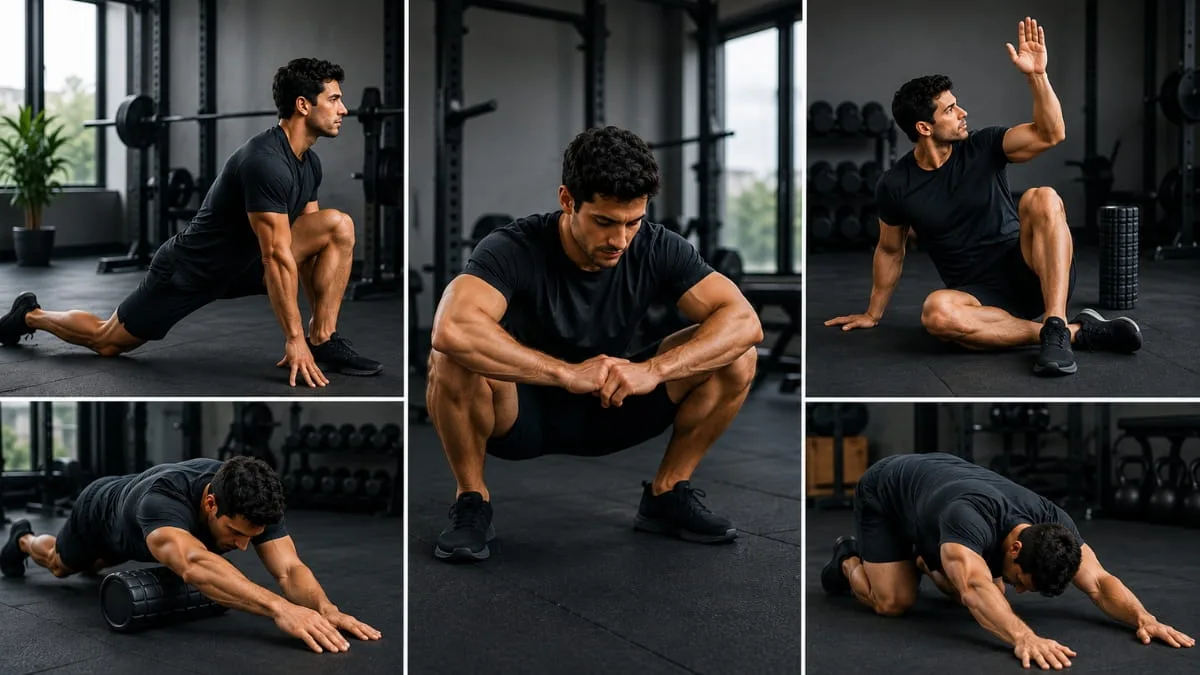
Movements that actively take your joints through a full range of motion — leg swings, walking lunges with a twist, arm circles, hip openers — prepare your body both physically and mentally for the work ahead. Research consistently shows dynamic warm-ups improve musculoskeletal readiness, joint mobility, and neuromuscular activation heading into a session, which is exactly why they've become the default pre-training approach over static stretching.
2. Controlled Articular Rotations (CARs)
These are slow, deliberate, active rotations that take a single joint through its complete available range — think slow shoulder circles, hip CARs, or ankle circles, performed under full muscular control rather than momentum. Unlike passive stretching, CARs train your nervous system to actively access and control end-range positions, which is closer to what mobility actually means for strength training.
3. Loaded End-Range Work
Rather than passively relaxing into a stretched position, some approaches require an isometric contraction right at the end of your available range — building strength specifically in the position where you're usually weakest. This combines the benefits of increased range with the strength to actually use it under load, addressing the core limitation of passive flexibility work.
4. Targeted Joint-Specific Mobility Drills
Most lifters have one or two specific bottlenecks — commonly the ankles, hips, thoracic spine, or shoulders — rather than a uniform, full-body mobility deficit. Identifying your specific restriction (a squat that collapses forward usually points to ankle or hip mobility; an overhead press that arches your lower back usually points to shoulder or thoracic spine mobility) and targeting it directly is far more efficient than generic full-body stretching routines.
5. Movement-Specific Warm-Up Sets
Performing the actual lift you're about to do, at light load, through a deliberately full range of motion, is itself a form of mobility training. A few bodyweight or empty-bar squats taken slowly to full depth before loading the bar reinforces the exact mobility your working sets will demand.
Building Mobility Into Your Training Week
You don't need a separate hour-long mobility session to see results. Here's a practical structure:
- Before every lifting session: 5–10 minutes of dynamic warm-up and joint-specific drills targeting whatever you're about to train (hips and ankles before squats, shoulders and thoracic spine before pressing).
- After your session: This is the better time for longer static stretches, since you're not relying on immediate force production and the muscle is already warm.
- 1–2 dedicated mobility sessions per week: Slightly longer sessions (15–20 minutes) focused specifically on your known bottlenecks — using CARs, loaded end-range work, or targeted drills for your tightest areas.
This structure mirrors the same principle behind building any sustainable fitness system: small, consistent, well-placed habits compound far more reliably than occasional, lengthy sessions squeezed in only when something already feels tight or painful.
A Quick Self-Check: Where Is Your Mobility Actually Limited?
Rather than guessing, a few simple checks can point you toward your real bottleneck:
| If this happens... | The likely limitation is... |
|---|---|
| Heels lift or knees cave during a deep squat | Ankle dorsiflexion or hip mobility |
| Lower back arches excessively during overhead pressing | Shoulder flexion or thoracic spine mobility |
| Rounded lower back at the bottom of a deadlift | Hip hinge mobility or hamstring flexibility |
| Difficulty keeping elbows under the bar in a front squat | Wrist, shoulder, or thoracic spine mobility |
| One side noticeably tighter than the other in any lift | Asymmetric mobility — worth targeting individually |
Once you know your actual bottleneck, your mobility work becomes far more targeted and time-efficient than a generic "stretch everything" routine.
The Bottom Line
Mobility isn't a side activity you do when you have spare time — it's part of the infrastructure that determines how much of your strength you can actually express safely. The research is clear on the practical approach: favor dynamic, active mobility work before you lift, save longer static stretching for after your session or dedicated mobility days, and target your specific bottlenecks rather than stretching generically.
Improve the range you can control under load, and you're not just reducing injury risk — you're very likely unlocking strength gains that were already there, just inaccessible.
FAQs: Mobility for Strength Training
Q: What's the difference between mobility and flexibility?
A: Flexibility is the passive range of motion a joint can reach with outside help, like gravity or a stretch. Mobility is the active range of motion you can control and use under your own strength — which is what actually matters when you're lifting weight through that range.
Q: Should I stretch before or after lifting weights?
A: Favor dynamic, movement-based mobility work before lifting, since prolonged static stretching right before strength work can temporarily reduce force output. Save longer static stretches for after your session or for separate mobility-focused days.
Q: Is static stretching before a workout actually bad for strength?
A: Not inherently. Research shows static stretches held for 60 seconds or less per muscle have minimal effect on strength and power, while much longer holds are what's associated with temporary performance reductions. Duration, not the act of stretching itself, is the key variable.
Q: How much mobility work do I actually need each week?
A: A practical approach is 5 to 10 minutes of dynamic, joint-specific warm-up before each lifting session, plus 1 to 2 dedicated mobility sessions of 15 to 20 minutes per week targeting your specific bottlenecks, such as ankles, hips, or shoulders.
Q: Can improving mobility actually increase my lift numbers?
A: Yes, indirectly but meaningfully. Better mobility allows you to access more of your lift's full range of motion with proper form, which can improve force production, muscle recruitment, and reduce compensation patterns that often limit how much weight you can safely lift.
Q: What's the best mobility drill for squats specifically?
A: Ankle and hip mobility are the most common limiting factors in squat depth. Controlled articular rotations for the hips and ankles, combined with a few slow, full-depth bodyweight squats as part of your warm-up, directly target the mobility your working sets will demand.
Q: Can I improve mobility on rest days instead of training days?
A: Yes, dedicated mobility sessions on rest days are a great way to make consistent progress on specific bottlenecks without competing for energy with your strength training. Just keep in mind that mobility gained in isolation still needs to be reinforced through your actual lifts to translate into usable strength.