On this page
- Why Most Indian Fat Loss Attempts Fail
- The Calorie Framework: Finding Your Target
- The Macro Split for Indian Fat Loss
- The High-Protein Indian Plate
- The Protein Gap Solution: India-Specific Sources
- 7-Day Indian Fat Loss Meal Plan
- What to Eat More Of, Less Of, and Avoid Entirely
- Practical Tips for Busy Urban Professionals
- Keeping It Sustainable: The Non-Negotiables
- The Bottom Line
- FAQs: Indian Diet Plan for Fat Loss
No boiled chicken, no imported superfoods, no crash dieting. Here's a realistic, fully Indian approach to fat loss — built around the food you already eat, with the portions and protein your body actually needs.
Somewhere between "eat only salads" and "drink green detox juice every morning," the actual, effective way to lose fat on an Indian diet got lost. The truth is quieter and considerably more practical: Indian cuisine — dal, sabzi, roti, curd, paneer, rajma — is genuinely well-suited to fat loss, not despite being Indian food, but partly because of what it's built around. The problem isn't the food itself. It's the proportions and the protein gap.
This guide gives you a complete framework: the principles, the calorie targets, a full-day meal structure, a sample 7-day plan, and exactly which Indian foods do the heavy lifting for fat loss — based on current research and aligned with the ICMR-NIN 2024 Dietary Guidelines for Indians.
Why Most Indian Fat Loss Attempts Fail
Before building the plan, it's worth understanding what typically goes wrong:
The protein gap is massive. Research and coaching data consistently show that the average active Indian adult consumes only 40 to 50 grams of protein per day — roughly half of what someone training regularly actually needs. When you're in a calorie deficit with insufficient protein, your body burns muscle alongside fat, leaving you lighter but softer, with a slower metabolism than when you started. As we've covered in detail in our complete guide to protein requirements, active individuals need 1.6 to 2.2 grams per kilogram of body weight — not the baseline sedentary RDA.
The roti-rice-as-main-event problem. A typical Indian plate allocates the majority of its volume and calories to rice or roti, with dal and sabzi serving as supporting characters. For fat loss, this ratio needs to reverse: protein-dense foods (dal, paneer, curd, soya, legumes) should be the anchor of each meal, with grains in a supporting role providing energy rather than dominating the plate.
The crash-diet spiral. Aggressive restriction, skipping meals, or surviving on fruit and salad creates the all-too-familiar cycle of restriction → intense hunger → overeating → guilt → repeat. A sustainable Indian fat loss diet keeps calories moderate enough to feel manageable daily, not extreme enough to feel heroic for a week before collapsing.
The Calorie Framework: Finding Your Target
The ICMR-NIN 2024 guidelines use a reference sedentary adult of 65 kg burning approximately 2,000 kcal/day as their baseline. Real-world data suggests:
- Sedentary-to-lightly-active Indian men (desk job, minimal exercise): Maintenance ~2,000–2,400 kcal/day
- Sedentary-to-lightly-active Indian women: Maintenance ~1,600–2,000 kcal/day
- Moderately active (training 3-4x/week): Add roughly 200–400 kcal to these estimates
For sustainable fat loss — defined by WHO and ICMR as 0.5 to 1 kg per week, the rate that best preserves muscle and keeps metabolism intact — you need a daily deficit of roughly 400 to 600 calories below maintenance. This produces:
- Men targeting fat loss: approximately 1,600–1,800 kcal/day
- Women targeting fat loss: approximately 1,200–1,500 kcal/day
These aren't rigid floors — they're starting points. If you're strength training, you may find you need slightly more to maintain training quality, which is almost always worth it. A calorie target you can maintain without misery for three months outperforms a more aggressive number you abandon after three weeks.
The Macro Split for Indian Fat Loss
Rather than obsessing over exact percentages, think about this in practical food terms:
Protein: 25–30% of total calories The most important, most under-consumed macro. For a 70 kg person, this means targeting 110–140g daily. Every meal needs a meaningful protein source — not just a garnish of dal on a plate of rice.
Carbohydrates: 40–50% of total calories India's dietary backbone, and not something to eliminate. Focus on complex, fiber-rich carbohydrates — whole wheat roti, brown rice, oats, jowar, bajra, millets — which digest more slowly, keep blood sugar stable, and support sustained energy through training. The ICMR specifically recommends combining cereals and pulses in a roughly 3:1 ratio to improve overall protein quality of each meal.
Fats: 20–30% of total calories Don't fear healthy fats — ghee in moderation, mustard oil, groundnut oil, nuts, and seeds all belong here and support satiety. What to limit: deep-frying, excess ghee, and the invisible fats in ultra-processed foods (namkeen, biscuits, packaged snacks) that add calories without any nutritional return.
The High-Protein Indian Plate
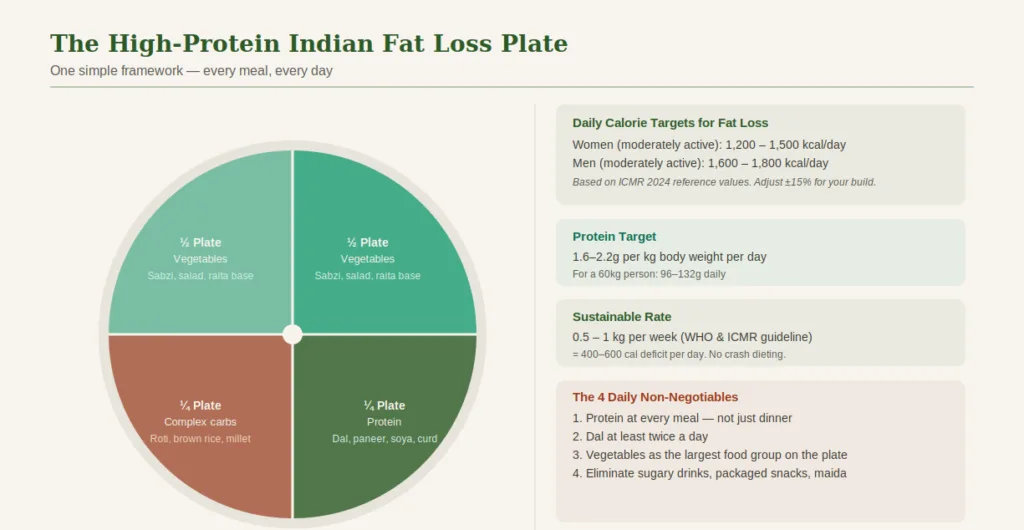
Think of your plate as divided into four parts:
- Half the plate: vegetables — cooked sabzi, salad, raita base
- One quarter: protein — paneer, dal, rajma, chole, soya, curd, tofu, or egg for those who include it
- One quarter: complex carbs — 1-2 rotis, a small serving of brown rice, or millet-based options
This simple ratio naturally increases protein and fiber while moderating carbohydrate volume, without requiring you to track every gram or give up food you love.
The Protein Gap Solution: India-Specific Sources
This is where an Indian fat loss diet lives or dies. Here's how to build meaningful protein into every meal using foods that are genuinely accessible and affordable:
Morning options: Moong dal chilla (2 pieces = ~14g), paneer bhurji with 100g paneer (~19g), 2 eggs (~12g), hung curd 200g (~20g), besan chilla with green chutney (~12-15g)
Lunch anchors: 1 cup rajma (~15g), 1 cup chole (~14g), 100g paneer sabzi (~19g), 1 cup mixed dal (~12-15g)
Dinner staples: Dal tadka with 1 cup cooked dal (~12g), tofu stir-fry 100g (~10g), soya chunk masala with 30g dry chunks (~15g), palak paneer with 100g paneer (~19g)
Snacks that add protein: Roasted chana 30g (~9g), hung curd with seeds (~12g), a handful of peanuts (~7g per 30g), small bowl of sprouted moong (~7g)
For a comprehensive breakdown of every major Indian vegetarian protein source with realistic gram values, our complete guide to high-protein vegetarian foods in India covers this in full detail.
7-Day Indian Fat Loss Meal Plan
This plan is designed for a moderately active adult targeting approximately 1,600–1,800 kcal/day with 110–130g protein daily. Adjust portions up or down by roughly 10-15% based on your specific calorie target. All portions are cooked/prepared quantities unless noted.
Day 1 — Monday
Breakfast (7:30–8:00 AM) | ~350 kcal | ~22g protein 2 moong dal chillas + 150g hung curd with cumin and salt + 1 cup black chai (no sugar)
Mid-morning snack (10:30–11:00 AM) | ~120 kcal | ~8g protein 30g roasted chana
Lunch (1:00–1:30 PM) | ~480 kcal | ~28g protein 1 cup rajma (cooked) + 2 whole wheat rotis + large cucumber-tomato salad + raita (100g curd)
Evening snack (4:00–4:30 PM) | ~100 kcal | ~7g protein Small handful peanuts (25g)
Dinner (7:30–8:00 PM) | ~420 kcal | ~26g protein 100g paneer bhurji (with onion, tomato, capsicum) + 1 roti + 1 bowl mixed vegetable sabzi + small bowl moong dal
Daily total: ~1,470 kcal | ~91g protein (scale portions up by 15-20% for higher-calorie targets or active men)
Day 2 — Tuesday
Breakfast | ~360 kcal | ~20g protein Oats upma (50g dry oats, mixed vegetables) + 1 boiled egg OR 50g paneer cubes on the side + green tea
Mid-morning | ~110 kcal | ~10g protein 1 cup Greek yogurt / hung curd (plain, no sugar)
Lunch | ~490 kcal | ~27g protein 1 cup dal tadka (masoor) + 1 cup brown rice (cooked, 150g) + palak sabzi + small kumro raita
Evening snack | ~130 kcal | ~8g protein Sprouted moong chaat with lemon, tomato, onion (small bowl)
Dinner | ~410 kcal | ~25g protein Soya chunk masala (30g dry chunks) + 2 rotis + lauki sabzi + small curd bowl
Day 3 — Wednesday
Breakfast | ~340 kcal | ~21g protein Besan cheela (2 pieces) with green chutney + 1 glass low-fat milk
Mid-morning | ~100 kcal | ~6g protein 1 small banana + 5 almonds
Lunch | ~470 kcal | ~26g protein 1 cup chole (kabuli chana) + 2 rotis + large mixed salad + 100g curd
Evening snack | ~120 kcal | ~9g protein Makhana (fox nuts) 30g, lightly roasted with rock salt
Dinner | ~400 kcal | ~24g protein Tofu bhurji (100g tofu with onion, tomato, turmeric, cumin) + 1 roti + baingan sabzi + dal soup
Day 4 — Thursday
Breakfast | ~370 kcal | ~23g protein Paneer paratha (1 medium, 50g paneer stuffing) + 100g curd + green chutney (lower ghee, cook on non-stick)
Mid-morning | ~90 kcal | ~5g protein 1 fruit (guava, apple, or pear)
Lunch | ~500 kcal | ~29g protein Dal khichdi (50g moong dal + 40g rice, cooked with turmeric, jeera) + raita + mixed vegetable sabzi
Evening snack | ~110 kcal | ~7g protein Roasted peanuts (25g) + lemon water
Dinner | ~400 kcal | ~25g protein Palak paneer (100g paneer) + 1 roti + tinda/lauki sabzi
Day 5 — Friday
Breakfast | ~350 kcal | ~20g protein 2 egg bhurji (for those who include eggs) OR 2 moong dal chillas + 1 cup chai, no sugar
Mid-morning | ~120 kcal | ~8g protein Hung curd (100g) with 1 tsp seeds (sunflower or pumpkin)
Lunch | ~460 kcal | ~26g protein Rajma chawal — 1 cup rajma + small bowl brown rice + kachumber salad + small curd
Evening snack | ~100 kcal | ~6g protein Green tea + small handful roasted chana
Dinner | ~420 kcal | ~27g protein Soya keema (30g dry chunks, cooked with peas and spices) + 2 rotis + bottle gourd sabzi
Day 6 — Saturday (slightly more flexible)
Breakfast | ~380 kcal | ~22g protein Dosa (1 medium) with sambar (1 cup) + coconut chutney (small) + green tea
Mid-morning | ~130 kcal | ~9g protein Greek yogurt 150g with a few berries or cut fruit
Lunch | ~500 kcal | ~28g protein Dal makhani (lighter version, no cream) 1 cup + 2 rotis + salad + raita
Evening snack | ~120 kcal | ~5g protein Bhutta (corn on the cob, without butter) + lemon + chat masala
Dinner | ~400 kcal | ~24g protein Paneer tikka (grilled, 100g) + 1 roti + mint raita + cucumber salad
Day 7 — Sunday (recovery and reset day)
Breakfast | ~360 kcal | ~21g protein Poha (80g dry) with green peas, peanuts, and curry leaves + 1 hard-boiled egg OR side of curd
Mid-morning | ~100 kcal | ~6g protein 1 fruit + 5 walnuts
Lunch | ~480 kcal | ~26g protein Chole curry (1 cup) + 2 rotis + large salad + 100g curd
Evening snack | ~110 kcal | ~7g protein Makhana (30g) + green tea
Dinner | ~400 kcal | ~24g protein Moong dal tadka + mixed vegetable sabzi + 1 roti + small bowl of sabut masoor (whole lentil)
What to Eat More Of, Less Of, and Avoid Entirely
Eat more of: Fresh vegetables in every meal, dal in at least two meals per day, curd or paneer daily, high-fiber complex carbs like jowar, bajra, whole wheat and oats, water (at least 2.5 litres daily per ICMR guidelines), and green tea without sugar.
Eat less of: White rice (reduce portion size, don't eliminate), refined flour (maida) products, added sugar and sweetened drinks including packaged fruit juices, excessive ghee or oil (use in moderation, not liberally), and large quantities of high-GI foods late in the evening.
Avoid or minimize: Packaged namkeen and chips, biscuits and bakery products (these are often loaded with trans fats), sugary chai taken multiple times per day, cold drinks and sodas, and ultra-processed "health snacks" that are marketed as diet-friendly but calorie-dense without meaningful protein or fiber. The 2024 ICMR-NIN guidelines specifically highlight ultra-processed foods as a category to restrict across the Indian diet, noting that enriching them with added nutrients doesn't make them healthful.
Practical Tips for Busy Urban Professionals
The most common reason Indian diet plans fail for urban professionals isn't motivation — it's logistics. A few systems that help:
Sunday prep matters. Boil a batch of rajma, chole, or soya chunks. Prep a large bowl of chopped salad vegetables. Cook extra roti dough and refrigerate. These small prep actions remove the decision fatigue that causes people to grab biscuits or order out on a Tuesday evening when they're tired.
Curd is your fastest protein fix. A bowl of hung curd takes zero time and delivers 15-20 grams of protein as a snack. Keep it stocked.
Dal at every meal is the simplest rule. A cup of dal at both lunch and dinner, consistently, adds 24-30 grams of protein without requiring much planning. If you eat dal twice a day, every day, you've already solved half your protein gap.
Shrink the roti before the dal. The easiest single portion adjustment: eat the same number of rotis but make them slightly smaller (medium instead of large), while adding a second cup of dal or a side of paneer. The calorie savings are meaningful and you're unlikely to feel the difference in fullness.
Keeping It Sustainable: The Non-Negotiables
A plan that works on paper but collapses under real life isn't a plan. The principles that determine whether any Indian diet plan actually holds up long-term come down to the same factors we've explored elsewhere on the blog:
Consistency over perfection. One chai with sugar or one plate of fried snacks at an office party doesn't undo a well-structured week. The all-or-nothing thinking that turns one slip into a full abandonment is the real diet-killer, not the occasional indulgence itself.
Sleep and stress are part of the plan. As covered in detail in our piece on how sleep affects fat loss, poor sleep raises cortisol and specifically promotes visceral fat storage — making adequate sleep a direct fat-loss lever, not a separate lifestyle goal.
Expect a plateau and have a plan for it. If the scale hasn't moved in three weeks of accurate tracking, review our complete breakdown of why fat loss stalls in a calorie deficit before reflexively cutting calories further.
Protein at every meal, not just dinner. The single most impactful change most Indian adults can make to their diet is simply front-loading protein into breakfast and lunch instead of saving it all for the evening meal.
The Bottom Line
A genuinely sustainable Indian diet plan for fat loss doesn't require you to give up roti, abandon dal, or start eating boiled chicken breast. It requires a proportional shift: more protein, more vegetables, slightly smaller carbohydrate portions, and far less of the packaged, processed foods that sneak in the most calories with the least nutritional return. The food is already there in the Indian kitchen — the shift is in how you proportion the plate.
FAQs: Indian Diet Plan for Fat Loss
Q: Can I lose fat without giving up roti and rice?
A: Yes. Roti and rice are not the problem — excess portions of them relative to protein and vegetables are. Reducing the size of carbohydrate servings while increasing dal, paneer, and sabzi naturally creates a better calorie and protein balance without eliminating staple foods.
Q: How many rotis per day is appropriate for fat loss?
A: This depends on your total calorie target, but for most women targeting 1,200–1,500 kcal/day, 2–4 medium whole wheat rotis across the day works well. For men at 1,600–1,800 kcal, 4–6 is a reasonable range. Switching to slightly smaller rotis rather than fewer is often easier to sustain.
Q: Is ghee allowed on a fat loss diet?
A: In moderation, yes. The ICMR recommends using fats and oils moderately, including traditional options like ghee and mustard oil. A small amount (half a teaspoon) per roti is reasonable; cooking everything generously in ghee is not.
Q: How much protein does a typical Indian vegetarian fat loss diet provide?
A: Without deliberate planning, typical Indian vegetarian diets provide 40–50g of protein daily — too low for an active person trying to preserve muscle during fat loss. With the meal structure in this plan — two dal servings daily, paneer or soya at one meal, curd as a snack — you can realistically reach 90–130g without supplements.
Q: Do I need to eat only "diet foods" to lose fat?
A: No. Most traditional Indian foods — dal, sabzi, curd, roti, rice, fruits — are genuinely diet-compatible when eaten in appropriate portions. What undermines fat loss is excess oil, added sugar, refined flour products, and packaged snacks, not the traditional foods themselves.
Q: Should I cut carbs completely for faster fat loss?
A: Not recommended. Carbohydrates provide the energy your training and daily function depend on, and eliminating them tends to reduce training quality, increase muscle loss risk, and make the diet nearly impossible to sustain socially. Reducing refined carbohydrates and managing total portions is more effective and more sustainable than elimination.
Q: How quickly should I expect to see results?
A: A sustainable rate of fat loss is 0.5 to 1 kilogram per week, as recommended by both ICMR and WHO. At this pace, 4–5 kilograms per month is achievable without muscle loss, metabolic slowdown, or the rebound that typically follows faster, more aggressive approaches.
Note: The calorie and macro figures in this plan are approximate estimates for planning purposes. Individual requirements vary by height, weight, age, activity level, and health status. Consult a registered dietitian for a personalized plan, particularly if you have any medical conditions.