
On this page
- First: Are You Actually in a Deficit?
- Your Real TDEE Might Be Different Than the Formula Says
- Water Retention Is Probably Hiding Real Fat Loss
- Metabolic Adaptation Has Quietly Lowered Your Calorie Needs
- You Might Be Recomping, Not Just Losing
- Sleep, Stress, and Recovery Are Working Against You
- An Underlying Medical Condition Could Be a Factor
- How Long Should You Wait Before Concluding Something's Wrong?
- The Bottom Line
- FAQs: Not Losing Weight in a Calorie Deficit
Tracking every meal, staying under your calorie target, and the scale still won't move? Here's the real, research-backed explanation — and how to find out exactly what's going on.
On paper, this shouldn't be possible. A calorie deficit is supposed to mean weight loss — that's basic thermodynamics. So when you've been eating less than you burn for weeks and the scale refuses to cooperate, it's easy to start wondering if your body is somehow an exception to the rule.
Here's the reassuring news: it almost certainly isn't. What's far more likely is one of a handful of well-documented, fixable reasons — some about the numbers themselves, some about what's happening in your body that the scale can't see. Let's work through them systematically.
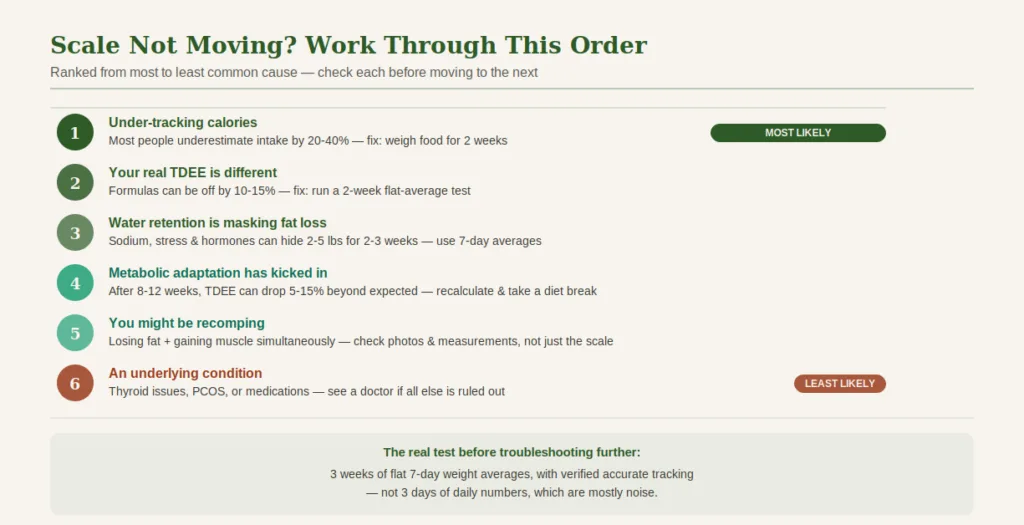
First: Are You Actually in a Deficit?
This is the question nobody wants to hear, but it's the one the research keeps coming back to. A classic study published in the New England Journal of Medicine — one of the most cited findings in this entire area — found that people under-report their food intake by roughly 20 to 40% on average, and by as much as 47% among people who specifically describe themselves as "diet-resistant." This isn't about dishonesty; it's about how naturally easy it is to miss things.
A few specific patterns drive this:
- Portion misjudgment. What you picture as a "serving" and what's actually on your plate are often meaningfully different, especially for calorie-dense foods like oils, nut butters, and dressings.
- Hidden extras. Cooking oil, sauces, condiments, and the small tastes and bites that happen while cooking rarely make it into a food log, but they add up fast.
- Eating back exercise calories. Many people see "you burned 400 calories" on a fitness tracker and eat more to compensate — but consumer fitness trackers commonly overestimate calorie burn by 20 to 40%, meaning that "earned" food is often inflated well beyond what was actually burned.
- Inconsistent tracking on weekends or social occasions. Diligent tracking on weekdays, looser tracking when eating out or at events, can quietly erase several days' worth of deficit each week.
The fix: For two weeks, track with real precision — weighing food rather than eyeballing it, logging everything including oils and drinks, and not adjusting intake upward based on exercise estimates. This single change resolves a surprisingly large share of "stuck" cases.
Your Real TDEE Might Be Different Than the Formula Says
Even with perfect tracking, the calorie target itself might be off. TDEE (Total Daily Energy Expenditure) calculators provide estimates, not guarantees — and your actual number can run 10 to 15% higher or lower than what a formula predicts, due to genetic variation in metabolic rate, your specific body composition, and how much you naturally move throughout the day (formally known as NEAT) outside of structured exercise.
There's a simple, practical way to find your actual number rather than relying on a formula: eat a precisely tracked, consistent calorie amount for two full weeks and track your 7-day average weight at the start and end. If your weight stayed flat, that calorie amount is your true maintenance level — not whatever a calculator estimated. This kind of direct empirical test is more reliable than any predictive equation, because it reflects your actual physiology rather than a population average.
The fix: If you've been stuck despite seemingly accurate tracking, don't assume the formula-derived target is correct. Run the two-week flat-average test and recalibrate from there.
Water Retention Is Probably Hiding Real Fat Loss
This is one of the most well-documented — and most reassuring — explanations on this entire list. Water makes up roughly 50 to 70% of your body weight, and several common factors cause it to fluctuate independently of fat loss:
- Sodium and carbohydrate intake. A single salty, processed, or carb-heavy meal can cause 2 to 5 pounds of water retention that takes 2 to 3 days to clear.
- Stress and cortisol. Prolonged dieting itself raises cortisol, and elevated cortisol promotes water retention — meaning the stress of dieting can partially mask the very results the diet is producing.
- Hormonal cycles. Natural hormonal fluctuations, including the menstrual cycle, commonly cause temporary water weight shifts unrelated to fat.
- Exercise-induced glycogen storage. Starting a new training program causes muscles to store more glycogen, which binds to water and can add scale weight even as body fat decreases.
This effect can be dramatic. The phenomenon is sometimes referred to informally as a "whoosh" — weight staying flat for days or weeks despite a real deficit, then dropping suddenly once retained water is released, often triggered by a higher-calorie or higher-carbohydrate meal that helps lower elevated cortisol. It's worth noting that this idea is frequently illustrated using the 1940s Minnesota Starvation Experiment, but that study examined near-famine conditions in a research context, not a typical fat-loss diet, so it's better understood as an illustration of the underlying water-retention mechanism than as direct proof of what happens during an ordinary deficit. The core mechanism — water retention obscuring real fat loss until it's released — is well documented in more directly applicable research on dieters, even if the popular Minnesota Experiment retelling oversimplifies the original study.
The fix: Don't judge progress by a single day's number. Track your 7-day rolling average instead of daily weight, and give a true plateau at least 2 to 3 weeks of flat averages before concluding something is actually wrong.
Metabolic Adaptation Has Quietly Lowered Your Calorie Needs
As you lose weight, your body genuinely needs fewer calories to maintain itself — a smaller body simply requires less energy. But on top of that expected change, sustained dieting triggers metabolic adaptation, where your body becomes more energy-efficient than the math alone would predict. Research suggests this effect can lower your total energy expenditure by an additional 5 to 15% beyond what your weight loss alone would explain, primarily through a lower resting metabolic rate and a quiet reduction in NEAT — fewer fidgets, shorter daily strides, more sitting without you consciously deciding to move less.
If you've been dieting continuously for more than around 8 to 12 weeks, this adaptation is a very plausible part of what's going on, especially if your calorie target hasn't been adjusted since you started.
The fix: Recalculate your intake every 10 to 15 pounds lost rather than sticking with your original number indefinitely, and consider a structured diet break — roughly 1 to 2 weeks at maintenance calories — every 8 to 12 weeks of continuous dieting to help counteract this adaptation.
You Might Be Recomping, Not Just Losing
If you're strength training while in a deficit, it's possible to be losing fat and gaining or maintaining muscle simultaneously — a process generally referred to as body recomposition. Since muscle is denser than fat, this can mean your body is changing shape and composition in exactly the direction you want, while the scale stays surprisingly steady. This is far more likely if you're newer to strength training, since that's when the muscle-building response to resistance training tends to be most pronounced even while in a deficit.
The fix: Track measurements, progress photos, and how clothes fit alongside the scale, not instead of it. A stalled number with a visibly changing body is a sign of progress, not a stalled plan.
Sleep, Stress, and Recovery Are Working Against You
It's tempting to think of weight loss as a purely mathematical problem, but poor sleep and chronic stress create real physiological headwinds. Beyond the cortisol-driven water retention already mentioned, inadequate sleep is linked to increased appetite and altered reward-center activity in the brain, which can chip away at the consistency a deficit depends on without you fully noticing it happening. We've covered the deeper hormonal mechanics of this in our piece on how sleep affects muscle growth and fat loss, which is worth a closer look if this might be playing a role for you.
The fix: Treat consistent sleep and stress management as part of the deficit itself, not a separate wellness goal running alongside it.
An Underlying Medical Condition Could Be a Factor
In a smaller number of cases, a real medical condition makes weight loss genuinely harder, even with a true, well-tracked deficit. Conditions like hypothyroidism can slow metabolic rate and cause water and salt retention, while PCOS can drive insulin resistance and altered fat storage that work against typical calorie-deficit responses. Certain medications — including some antidepressants, beta-blockers, and hormonal contraceptives — can also independently cause weight gain or water retention.
The fix: If you've genuinely ruled out tracking errors, water retention, and metabolic adaptation, and a true plateau has persisted for several weeks despite a verified deficit, it's a reasonable and worthwhile time to talk to a doctor rather than continuing to tighten the diet further on your own.
How Long Should You Wait Before Concluding Something's Wrong?
This matters more than people think. The right test is three weeks of weekly weight averages, not three days of daily readings. Body weight naturally varies by roughly 1 to 2% day to day from food, fluid, and timing alone — which means a few "bad" daily numbers in a row tell you almost nothing. If your 7-day average has been genuinely flat for three consecutive weeks while your tracking has been verified as accurate, that's the point where troubleshooting the deeper causes above actually makes sense.
This same patience matters for your mindset, too — concluding too early that "nothing is working" and abandoning a sound plan is exactly the kind of all-or-nothing thinking that derails progress that was, in many cases, already happening quietly beneath the surface.
The Bottom Line
A genuine, sustained calorie deficit will produce fat loss — that part of the equation hasn't changed. What changes, far more often than people expect, is whether the deficit is actually as large as believed, whether the scale is currently reflecting water rather than fat, or whether weeks of dieting have quietly shifted your body's energy needs. None of these explanations require you to be uniquely "broken" or resistant to normal biology.
Work through the list systematically — verify your tracking, question your TDEE, give water retention time to settle, account for metabolic adaptation, and consider recomposition — before assuming the deficit itself has failed. In the overwhelming majority of cases, it hasn't.
FAQs: Not Losing Weight in a Calorie Deficit
Q: How long should I stay in a deficit before assuming something is wrong?
A: Use three weeks of weekly weight averages, not a few days of daily readings, as your real test. Body weight naturally fluctuates day to day, so a genuine plateau means your 7-day average has stayed flat for at least three consecutive weeks despite verified, accurate tracking.
Q: Could I be under-tracking my calories without realizing it?
A: Yes, and it's extremely common. Research has found that people underestimate their food intake by roughly 20 to 40% on average, often due to portion misjudgment, untracked oils and condiments, and eating back inflated exercise-calorie estimates from fitness trackers.
Q: Why does my weight go up after a high-calorie or salty meal even though I'm in a deficit?
A: This is almost always water retention rather than fat gain. A single salty or carbohydrate-heavy meal can cause 2 to 5 pounds of temporary water weight that typically clears within 2 to 3 days, and doesn't reflect any actual change in body fat.
Q: What is metabolic adaptation and how much does it actually slow weight loss?
A: Metabolic adaptation is your body becoming more energy-efficient in response to sustained calorie restriction, beyond what weight loss alone would explain. Research suggests this can reduce total energy expenditure by an additional 5 to 15%, primarily through a lower resting metabolic rate and reduced everyday movement.
Q: Can I be losing fat even if the scale isn't moving?
A: Yes, this is possible through a process called body recomposition, where you lose fat while gaining or maintaining muscle simultaneously, particularly if you're newer to strength training. Tracking measurements and progress photos alongside the scale gives a more complete picture than weight alone.
Q: When should I see a doctor about a weight loss plateau?
A: If you've carefully verified your tracking accuracy, accounted for water retention with multi-week averages, and considered metabolic adaptation, but a true plateau has persisted for several weeks, it's reasonable to consult a doctor to rule out underlying conditions like hypothyroidism or PCOS.
Q: Does stress actually affect weight loss, or is that overstated?
A: It's a real factor. Chronic stress raises cortisol, which promotes water retention and can mask fat loss on the scale, and poor sleep is separately linked to increased appetite and reduced consistency. Both can meaningfully interfere with a deficit even when the calorie math itself is sound.