
On this page
- What Motivation Actually Is, Biologically
- Where Discipline Comes From — and Why It Feels Easier Over Time
- Motivation vs. Discipline: A Side-by-Side Breakdown
- So Which One Actually Builds a Fit Body?
- The 4 Building Blocks of Real, Lasting Discipline
- The Bottom Line
- FAQs: Motivation vs Discipline in Fitness
Is motivation or discipline the real key to fitness results? Discover the science behind what actually builds a fit body for the long run.
"I just need to find my motivation again." If you've said this to yourself before a workout, you're not alone — and you're also not asking the right question. Motivation isn't something you find, like a missing sock. It's a chemical state that rises and falls, and it was never built to carry you through years of consistent training.
So if motivation isn't the answer, is discipline the real secret? Not exactly — and understanding the real relationship between the two is the difference between someone who trains for three weeks and someone who trains for life.
What Motivation Actually Is, Biologically
Motivation feels like willpower, but it's really chemistry. At the center of it sits dopamine — a neurotransmitter that fuels what scientists call approach motivation, the drive to pursue something rewarding. Research on the brain's dopamine circuitry shows that the concentration of dopamine in specific brain pathways directly shapes motivational states, with different levels producing distinctly different drives to act.
Here's the catch: dopamine spikes in response to novelty and anticipated reward — not repetition. That new gym membership, that first sign of visible progress, that exciting new program you just downloaded — all of these trigger a dopamine surge. But dopamine systems are designed to respond strongly to new stimuli and respond progressively less to the same stimulus over time. This is closely related to a phenomenon called hedonic adaptation: your brain gets used to positive experiences quickly, so the same workout that once felt thrilling eventually just feels normal — or worse, boring.
This isn't a flaw in your character. It's how the reward system in your brain has always worked.
Where Discipline Comes From — and Why It Feels Easier Over Time
Discipline, on the other hand, isn't a personality trait you either have or don't. It's the product of a specific neurological shift.
In the early stages of any new behavior, your prefrontal cortex — the part of your brain responsible for planning, decision-making, and self-control — has to actively manage every single rep of the process. That's exhausting, which is exactly why a new habit feels so effortful at first.
But with enough repetition, control quietly shifts. Neuroscience research on habit formation shows that as a behavior becomes ingrained, the prefrontal cortex's involvement diminishes, handing control over to the basal ganglia — a deeper brain structure responsible for automatic, habitual behavior. Once that handoff happens, the behavior stops requiring conscious willpower altogether. It becomes closer to autopilot than effort.
This is the real definition of discipline: not gritting your teeth forever, but training your brain to make a behavior automatic enough that it no longer needs willpower to execute.
Motivation vs. Discipline: A Side-by-Side Breakdown
| Motivation | Discipline | |
|---|---|---|
| Source | Emotional, chemical (dopamine-driven) | Behavioral, structural (habit-driven) |
| Trigger | Novelty, excitement, external events | Repetition, routine, environment |
| Reliability | Fluctuates with mood, sleep, stress | Stable once established |
| Best used for | Starting something new | Sustaining something long-term |
| Feels like | A rush, a spark | Showing up regardless of mood |
| Builds through | Inspiration, big goals, fresh starts | Small repeated actions, systems |
| Fails when | Life gets busy, results stall, novelty wears off | Rarely fails once automatic — but takes time to build |
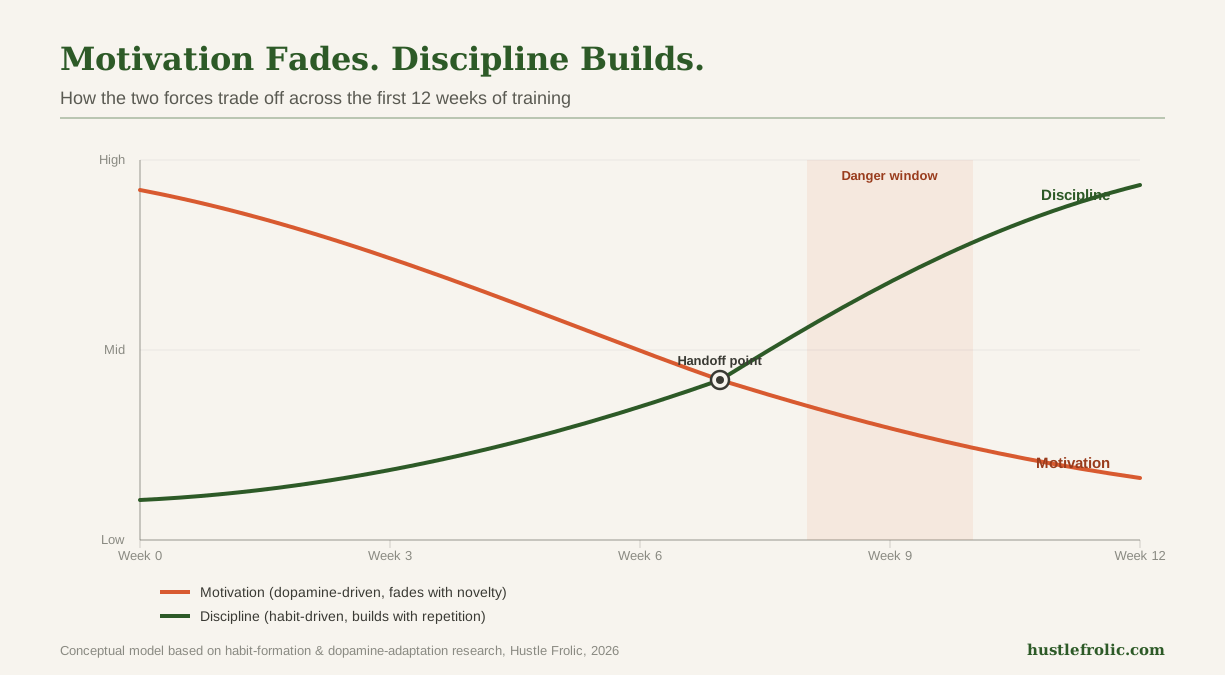
Notice that this isn't really a competition. Motivation and discipline aren't rivals — they operate on completely different timelines, doing two different jobs.
So Which One Actually Builds a Fit Body?
Here's the honest, slightly unsatisfying truth: neither one alone is enough. The fitness results that actually last come from understanding the role each one is supposed to play.
Motivation's Job: Getting You Started
Motivation is genuinely useful — for the first push. It's the spark that gets you to sign up, lace up your shoes for the first time in months, or commit to a new program. Nobody builds a habit without some initial activation energy, and motivation provides exactly that.
The mistake most people make isn't feeling motivated — it's assuming that feeling will stay high enough to carry them through months of training. It won't. And when it inevitably dips, many people interpret the dip as a personal failure rather than a completely normal, expected biological event.
Discipline's Job: Keeping You Going
Discipline is what takes over once the initial spark fades — but only if you've built the systems that allow it to form in the first place. According to a widely cited study published in the European Journal of Social Psychology, it takes an average of 66 days of consistent repetition for a behavior to start feeling automatic. That's roughly 8 to 12 weeks — which, not coincidentally, lines up almost exactly with the danger window we've written about before, where most people quit the gym entirely before discipline ever has the chance to take over from motivation.
This is the critical handoff point. If your training depends entirely on motivation past week 8 to 10, you're fighting biology. If you've built structure and repetition into that window instead, discipline starts doing the heavy lifting for you.
The Feedback Loop Nobody Talks About
Here's the part that makes this whole relationship work: discipline doesn't just replace motivation — it eventually regenerates it. Real progress, even small and slow, produces a fresh and more durable form of motivation than the kind you started with. This is the difference between extrinsic motivation (chasing an external reward like a compliment or a deadline) and intrinsic motivation (training because the process itself, or the visible progress, feels genuinely satisfying).
This shift from extrinsic to intrinsic motivation is well documented in exercise psychology — people who train for internal, self-valued reasons consistently show far better long-term adherence than those relying on external pressure alone. Discipline is what gives that intrinsic motivation enough time and repetition to actually develop.
The 4 Building Blocks of Real, Lasting Discipline
Knowing discipline matters more long-term doesn't automatically make it easier to build. Here's what actually works, based on how the underlying psychology functions.
1. Make the Behavior Embarrassingly Small at First
Discipline isn't built by forcing yourself through 90-minute sessions from day one — it's built by repetition. Starting with a version of the habit so small it feels almost too easy (putting on your gym shoes, doing one set, walking for 10 minutes) removes the resistance that would otherwise drain your prefrontal cortex before the habit has a chance to form.
2. Build Systems Instead of Relying on Daily Decisions
Every time you have to decide whether to work out, you're spending willpower — a limited resource. Pre-planned schedules, packed gym bags, and pre-decided fallback workouts for low-energy days remove decision-making from the equation entirely. We've covered this in detail in our guide to building sustainable systems for workout and diet consistency — the core idea is the same one driving the science here: structure outlasts willpower every time.
3. Protect the 8-to-12-Week Window Specifically
Since this is the exact period where most people lose momentum and motivation hasn't yet been replaced by automatic discipline, treat it as a critical, non-negotiable phase — not just another few weeks of training. Lower the intensity if needed, but don't lower the frequency. Consistency, not intensity, is what builds the neural pathway.
4. Don't Let One Missed Day Become a Dropped Habit
A single missed session has almost no impact on habit formation. The danger isn't the missed day — it's the all-or-nothing thinking that turns one skipped workout into a week, then a month, of inactivity. If this pattern sounds familiar, it's worth reading our breakdown of exactly why this mindset derails so much fitness progress — and more importantly, how to interrupt it before it starts.
The Bottom Line
Motivation and discipline were never meant to compete for the same job. Motivation is the spark that gets you off the couch for the first time. Discipline is the structure that keeps you showing up long after that spark has faded — built not through sheer willpower, but through small, repeated actions that quietly shift control from your effortful prefrontal cortex to your automatic basal ganglia.
So the next time you're waiting to "feel motivated" again, remember: you're not missing a feeling. You're missing a system. Build the system, protect the first 8 to 12 weeks, and let discipline do what motivation never could — carry you through years, not just weeks.
FAQs: Motivation vs Discipline in Fitness
Q: What's the real difference between motivation and discipline?
A: Motivation is an emotional, chemically driven state fueled largely by dopamine, which makes it powerful but short-lived. Discipline is a behavioral pattern built through repetition, which makes it slower to develop but far more stable once it's in place.
Q: Why does my motivation to work out disappear so quickly?
A: This is a normal result of how dopamine works. It responds strongly to novelty and fades as an activity becomes familiar, a process related to hedonic adaptation. Your brain isn't malfunctioning — it's simply doing what reward systems are designed to do.
Q: Is discipline something people are just born with?
A: No. Discipline is built through repetition, not inherited as a fixed trait. As a behavior is repeated consistently, control shifts from the effortful prefrontal cortex to the more automatic basal ganglia, which is what makes the behavior feel easier over time.
Q: How long does it take for discipline to replace motivation?
A: Research suggests it takes roughly 66 days on average — about 8 to 12 weeks — for a behavior to start feeling automatic. This window is also when most people are at the highest risk of quitting, which is exactly why protecting it matters so much.
Q: Can motivation come back once it fades?
A: Yes, but usually in a different form. Visible progress from consistent training tends to generate a more durable, intrinsic motivation than the original spark that got you started — but this new motivation is a byproduct of discipline, not a replacement for it.
Q: Should I just wait until I feel motivated to work out again?
A: This is generally not an effective long-term strategy, since motivation is designed to be unreliable and mood-dependent. A more effective approach is building small, structured habits that don't depend on feeling motivated in the moment.
Q: Do I need willpower to be disciplined?
A: Less than you'd think. The goal of discipline isn't to constantly fight yourself through willpower — it's to build systems and repetition strong enough that the behavior eventually requires very little conscious effort at all.