On this page
Think you can't hit your protein goals as an Indian vegetarian? You're working with more than enough food — you're just not eating it in the right proportions. Here's the complete, practical list.
"Vegetarians can't get enough protein" might be one of the most repeated, least accurate claims in Indian fitness culture. The truth is almost the opposite: India has one of the richest vegetarian food traditions in the world, built on dal, paneer, legumes, and dairy that collectively offer enormous protein potential. The real issue isn't availability — it's that a typical Indian plate is built around roti and rice as the main event, with dal and curd playing a supporting role, when it should often be the other way around.
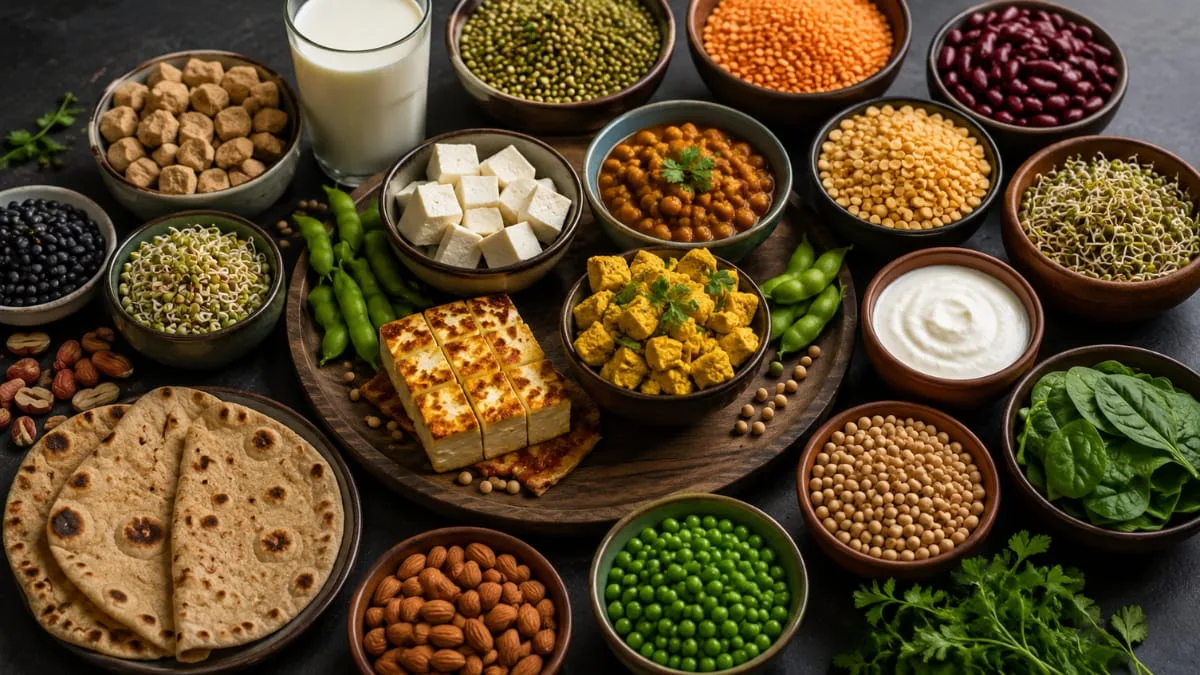
This guide covers the complete list of high-protein vegetarian foods available in India, with realistic numbers, practical serving sizes, and exactly how to combine them so you're not left guessing.
How Much Protein Do You Actually Need?
Before diving into the list, it helps to know your target. The Indian Council of Medical Research (ICMR) recommends a baseline of 0.8 to 0.83 grams of protein per kilogram of body weight per day for sedentary adults — for a 70 kg person, that's roughly 58 grams daily. If you're training regularly, that target rises significantly: research-backed guidance for active individuals and anyone strength training generally points to 1.6 to 2.2 grams per kilogram for muscle building or fat loss with muscle preservation.
For most active Indian adults, this means a daily target somewhere between 90 and 150 grams, depending on body weight and training intensity — a number most people significantly undershoot, not because the food isn't available, but because protein rarely gets prioritized at every meal.
The Complete List, By Category
Dairy-Based Protein (Lacto-Vegetarian Staples)
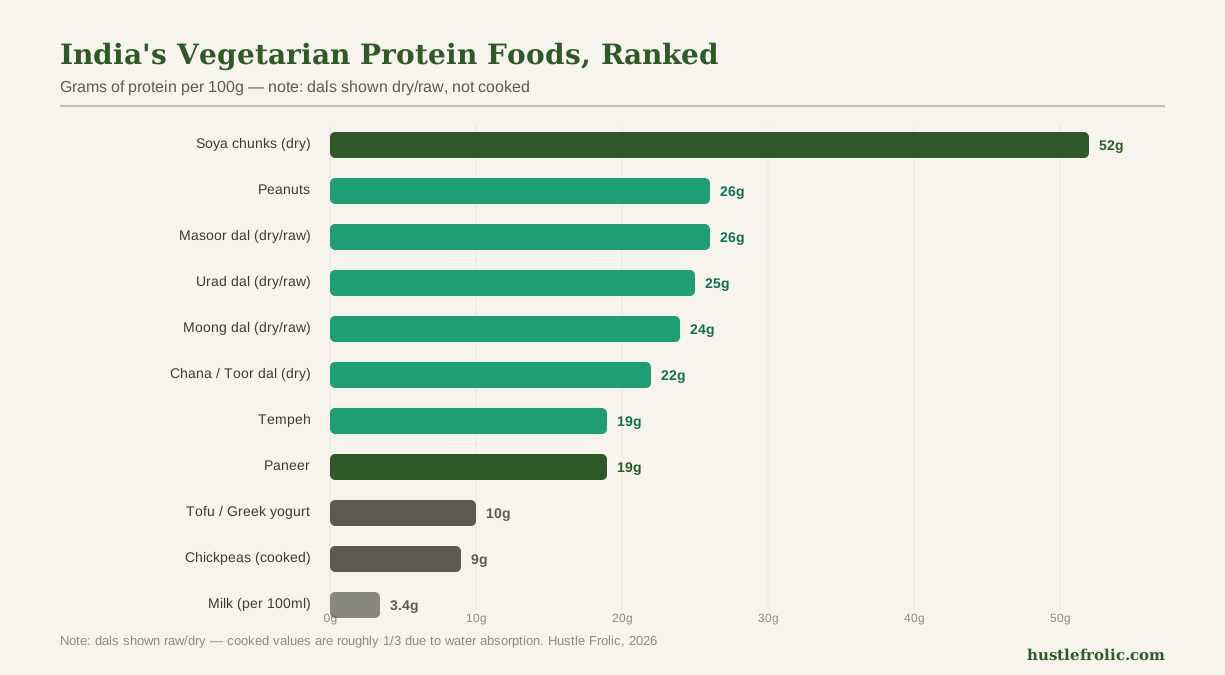
Paneer is the single most versatile high-protein food in the Indian vegetarian kitchen, delivering roughly 18 to 20 grams of protein per 100 grams. It's a near-complete protein, containing all essential amino acids, and works across breakfast (paneer bhurji), lunch (palak paneer), and snacks (grilled paneer tikka) without ever feeling repetitive. A 100–150g serving delivers 18–30g of protein in one sitting.
Greek yogurt or hung curd offers close to double the protein of regular dahi, at around 10 grams per 100 grams, while also providing gut-friendly probiotics. Hung curd is easy to make at home by straining regular curd through a cloth overnight, and works as a base for high-protein dips, marinades, or a simple breakfast bowl with seeds and fruit.
Milk contributes a more modest but meaningful 3.4 grams per 100ml, meaning a 500ml daily intake adds roughly 17 grams of protein to your day with almost no effort — a genuinely underrated, low-friction protein source.
Whey protein, despite sounding like a non-vegetarian product, is actually derived from milk and is fully suitable for lacto-vegetarians (though not for vegans). A single scoop typically delivers around 24 grams of protein, making it one of the most efficient ways to close a daily protein gap. For a deeper look at how this compares to whole foods, we've covered the full picture in our guide on whey protein vs. natural protein.
Lentils and Dals (The Everyday Workhorse)
Dals are the backbone of Indian vegetarian cooking, but it's worth being precise about their protein content, since this is where a lot of confusion happens. Raw, dry dals contain roughly 20 to 26 grams of protein per 100 grams — urad dal around 25g, masoor dal around 26g, chana dal and toor dal around 22g, and moong dal around 24g. But once cooked, that volume roughly triples while protein density drops, meaning a typical bowl of cooked dal delivers closer to 8 to 10 grams of protein per 100 grams cooked, with the rest of its calories coming mostly from carbohydrates.
This is an important distinction: dal is genuinely a good protein source, but treating it as your only protein source for a meal generally isn't enough on its own. A realistic serving of dal (around one cup cooked) provides roughly 12 to 15 grams of protein, which is meaningful but needs to be paired with other protein sources across the day to hit higher targets.
Rajma (kidney beans) stands out among legumes as a particularly strong option, delivering around 15 grams of protein per cooked cup — among the highest of the commonly eaten dals and beans, making rajma-chawal a legitimately solid protein meal rather than just a comfort-food classic.
Soy-Based Foods (The Protein Powerhouses)
If you're looking for the single most protein-dense vegetarian food widely available in India, this category has the clear answer.
Soya chunks (dry) contain an extraordinary ~52 grams of protein per 100 grams — higher than virtually any other commonly available food, vegetarian or not. They're inexpensive, widely available, and nearly flavor-neutral, meaning they readily absorb whatever masala or curry they're cooked in. Just 50g of dry soya chunks delivers roughly 26 grams of protein, making it one of the most cost-effective protein sources in the entire Indian vegetarian diet.
Tofu offers a gentler, more versatile option at around 10 grams per 100 grams, with a much milder taste and texture that works well in stir-fries, scrambles, and marinated preparations for those who find paneer too rich or dairy-heavy.
Tempeh, a fermented soy product, delivers around 19 grams per 100 grams and is generally easier to digest than unfermented soy due to the fermentation process — though it's less commonly available outside metro cities.
Soy is also notable as one of the only plant-based proteins with a genuinely complete amino acid profile comparable to animal protein, containing all nine essential amino acids in meaningful proportions, which sets it apart from most other plant foods that need to be combined to achieve the same completeness.
Legumes and Beans
Chickpeas (kabuli chana), whether boiled, roasted, or made into chole, deliver around 8 to 9 grams of protein per 100 grams cooked, with a full cup providing closer to 14–15 grams. They're also rich in fiber and rank low on the glycemic index, making them a smart choice for blood sugar management alongside protein goals.
Black chana, lobia (black-eyed peas), and chowli round out a category of underused but genuinely strong protein sources, each typically delivering protein in a similar range to chickpeas while bringing additional iron and fiber to the table.
Nuts and Seeds
This category is genuinely underused in most Indian diets despite being protein-dense and easy to add as snacks.
Peanuts deliver around 26 grams of protein per 100 grams — remarkably close to chicken — and are by far the most affordable nut option widely available across India. A peanut-banana shake or simply a handful of roasted peanuts makes for an easy, cost-effective protein top-up.
Pumpkin, sunflower, and sesame seeds collectively offer 15 to 25 grams of protein per 100 grams, alongside meaningful amounts of zinc, magnesium, and healthy fats — making a daily handful sprinkled over curd, salads, or smoothies a small but genuinely useful habit.
Almonds, while pricier than peanuts, deliver strong nutrient density alongside their protein content; 8–10 soaked almonds added to breakfast is a simple, traditional way to boost both protein and micronutrient intake.
Grains Worth Knowing About
Quinoa stands out as one of the few grains that qualifies as a complete protein, containing all nine essential amino acids — a genuine rarity among plant foods. It works well as a direct rice substitute in any Indian meal without requiring a recipe overhaul.
Amaranth (rajgira), a gluten-free pseudo-grain gaining renewed popularity in India, is also a complete protein and is particularly rich in lysine — an amino acid often lacking in standard grains — making it a smart addition for anyone whose diet leans heavily on wheat and rice.
The Amino Acid Piece: Why Combining Foods Matters
Most individual plant proteins are technically "incomplete," meaning they're lower in one or more of the nine essential amino acids your body can't produce on its own. This is where traditional Indian food pairings turn out to be quietly brilliant from a nutrition science standpoint, not just a matter of taste.
Lysine tends to be the amino acid most commonly low in grains, but it's abundant in legumes, dairy, and quinoa — which is exactly why dal-roti and rice-rajma combinations work so well together; the legume supplies the lysine that the grain is missing. Methionine, on the other hand, is often the amino acid low in legumes, but it's well supplied by sesame seeds, sunflower seeds, oats, and dairy — meaning a heavily legume-based diet benefits from a daily handful of seeds to round out the profile.
The practical takeaway here is reassuring: you don't need to obsessively pair specific foods within a single meal. Eating a genuinely varied diet across legumes, dairy, grains, nuts, and seeds throughout the day gives your body what it needs to combine these amino acids effectively on its own, without requiring meal-by-meal precision.
A Sample High-Protein Vegetarian Day
Here's what a realistic, roughly 100-gram-protein day looks like, built entirely from the foods above:
- Breakfast: 2 moong dal chillas + 200g hung curd — approximately 20g
- Mid-morning: A bowl of Greek yogurt with a handful of pumpkin seeds — approximately 24g
- Lunch: 1 cup rajma + 2 rotis — approximately 20g
- Snack: 30g dry soya chunks, boiled and lightly spiced — approximately 15g
- Dinner: 100g paneer sabzi + a small bowl of dal — approximately 26g
Total: roughly 105 grams — achieved entirely through whole foods, no protein powder required, though whey or a plant-based protein supplement can comfortably bridge any remaining gap on busier days.
Three Common Mistakes That Quietly Sabotage Vegetarian Protein Intake
Relying on dal as your only protein source. As covered above, a typical bowl of cooked dal is closer to 40% protein and 60% carbohydrate by composition. Treat dal as a solid contributor, not your entire protein strategy for a meal.
Loading up on roti and rice while treating protein as a side dish. The most common, fixable issue across Indian vegetarian diets isn't a lack of protein-rich foods — it's portion proportions. Doubling your dal or paneer portion while slightly reducing rice or roti often closes most of a daily protein gap without any other changes.
Assuming supplements are mandatory rather than optional. Whey and plant-based protein powders are genuinely useful tools for convenience and closing gaps, particularly on busy days — but as we've covered in detail elsewhere, whole foods generally remain the stronger foundation for overall nutrition, with supplements working best as a strategic addition rather than a replacement.
The Bottom Line
The idea that Indian vegetarians can't get enough protein doesn't hold up against the actual food landscape available. Between paneer, dal, soya chunks, rajma, peanuts, seeds, and dairy, there's more than enough protein density on offer — the real shift required is proportional: protein needs to show up at every meal, not just as an afterthought alongside rice and roti. Once that shift happens, hitting even an ambitious daily protein target through Indian vegetarian food alone becomes entirely realistic.
FAQs: High Protein Vegetarian Foods in India
Q: What is the highest protein vegetarian food available in India?
A: Dry soya chunks are the most protein-dense vegetarian food widely available in India, containing roughly 52 grams of protein per 100 grams — higher than most non-vegetarian foods including chicken breast. They're also inexpensive and easy to cook into everyday Indian dishes.
Q: Can Indian vegetarians really get enough protein without supplements?
A: Yes, with deliberate meal planning. A day built around dal, paneer, curd, legumes, and a handful of nuts or seeds can realistically provide 70 to 100+ grams of protein through whole foods alone. The challenge is consistency across meals, not the availability of protein-rich foods.
Q: Is dal alone enough to meet daily protein needs?
A: Not on its own. A typical bowl of cooked dal is roughly 40% protein and 60% carbohydrate by composition, providing around 8 to 10 grams of protein per 100 grams cooked. Dal is a solid contributor but works best combined with paneer, soy, legumes, or dairy rather than relied on exclusively.
Q: How much protein does paneer actually contain?
A: Paneer contains approximately 18 to 20 grams of protein per 100 grams and is considered a near-complete protein, since it contains all essential amino acids. A typical 100–150g serving provides roughly 18 to 30 grams of protein in a single meal.
Q: Do vegetarians need to combine specific foods at every meal to get complete protein?
A: Not at every single meal. While individual plant proteins are often missing certain amino acids, eating a genuinely varied diet across legumes, dairy, grains, nuts, and seeds throughout the day allows your body to combine these amino acids effectively without requiring precise meal-by-meal pairing.
Q: Is whey protein suitable for Indian vegetarians?
A: Yes. Whey protein is derived from milk during cheese production, making it suitable for lacto-vegetarians, though not for strict vegans. It's a convenient way to close protein gaps, particularly for those struggling to hit higher daily targets through food alone.
Q: How much protein do I need per day as an active Indian vegetarian?
A: The ICMR baseline for sedentary adults is roughly 0.8 grams per kilogram of body weight daily, but active individuals and anyone doing regular strength training generally benefit from a higher target of 1.6 to 2.2 grams per kilogram for effective muscle building and recovery.