On this page
- The Number Most People Start With Is Wrong
- The Research-Backed Ranges, by Goal
- Find Your Personal Number Right Now
- The Per-Meal Question: Does It Matter How You Spread It?
- Is There an Upper Limit? Can You Eat Too Much Protein?
- A Quick Reference: Your Number by Goal
- Common Protein Myths Worth Permanently Retiring
- The Bottom Line
- FAQs: How Much Protein Per Day
Everyone says "eat more protein," but nobody agrees on the actual number. Here's what the most current research says — and exactly how to find your personal target.
Ask three trainers how much protein you need and you'll get three different answers. Some will say 0.8 grams per kilogram. Others insist on 2 grams. A few will confidently tell you "1 gram per pound." The frustrating truth is that none of these numbers is universally right — the optimal amount genuinely varies based on your weight, goals, age, and training status.
The good news is that the research on this question is now detailed enough to give you a genuinely precise, personalized answer, and clear enough to permanently retire some of the most repeated myths in fitness. Let's go through all of it.
The Number Most People Start With Is Wrong
The figure most commonly cited as "the protein recommendation" is 0.8 grams per kilogram of body weight per day — the Recommended Dietary Allowance (RDA) established by national health bodies including the WHO. For a 70 kg person, that's roughly 56 grams per day.
Here's what most people quoting this number don't mention: the RDA wasn't designed to support optimal muscle mass, athletic performance, or meaningful body composition. According to researchers at Stanford University, the RDA was established specifically to prevent deficiency in the general population — essentially the minimum to avoid malnutrition — not to support optimal muscle retention or athletic performance. Multiple research bodies, including the European Society for Clinical Nutrition and Metabolism (ESPEN) and the PROT-AGE Study Group, have explicitly stated this baseline is insufficient for maintaining muscle mass, particularly in active individuals or older adults.
In practical terms: 0.8g/kg is a floor to stay healthy. It's not a target for anyone training regularly, managing body composition, or trying to preserve muscle mass during a fat-loss phase.
The Research-Backed Ranges, by Goal
For General Health and Light Activity
For sedentary or lightly active adults without specific muscle or body composition goals, a target of 1.0 to 1.2 grams per kilogram per day is well-supported as a meaningful step above the baseline RDA, particularly for adults over 40 where muscle maintenance becomes a more active process than it was at 25.
For Muscle Building
This is where the research gets both clearer and more interesting. A landmark 2018 meta-analysis published in the British Journal of Sports Medicine pooled data from 49 studies and 1,863 participants and identified a "breakpoint" for protein's effect on muscle gain at approximately 1.62 grams per kilogram per day — the point at which additional protein showed diminishing returns on lean mass accrual in trained individuals. The 95% confidence interval for this breakpoint runs from 1.03 to 2.20 g/kg/day, which tells you something important: there's genuine individual variation, and the practical target for most trained people is comfortably within the 1.6 to 2.2 grams per kilogram range.
More recent research using the Indicator Amino Acid Oxidation (IAAO) method — a more precise way of measuring actual protein needs than the older nitrogen-balance method — suggests that resistance-trained individuals may benefit from intakes toward the higher end of this range, with some evidence pointing to up to 2.4 grams per kilogram providing additional benefits for individuals with high lean body mass or higher training volumes.
For Fat Loss While Preserving Muscle
This is arguably where protein matters most, and where higher intakes pay the clearest dividends. When you're in a calorie deficit, your body is under pressure to break down muscle tissue for energy alongside fat. Research consistently shows that keeping protein higher during a cut — generally 1.8 to 2.4 grams per kilogram, with some studies recommending toward the upper end for leaner individuals closer to goal weight — best preserves lean mass during weight loss. A study in the International Weight Control Registry, published in 2025 across 203 participants, found that higher protein intake was independently associated with lower body fat percentage and greater muscle mass in weight-loss contexts, even after controlling for physical activity.
For Older Adults (40+)
Protein requirements don't decrease with age — if anything, they increase. Research shows that older adults develop what's called anabolic resistance: a reduced sensitivity of muscle to the protein synthesis-triggering signal of amino acids, meaning more protein is needed to produce the same muscle-building response as in younger adults. ESPEN and the PROT-AGE Study Group recommend at least 1.2 grams per kilogram daily for healthy older adults, rising to 1.5 g/kg or beyond for those managing chronic conditions or recovering from illness. For older adults who are also strength training, targeting the 1.6–2.0 g/kg range is increasingly supported by the evidence.
Find Your Personal Number Right Now
Rather than working through these calculations manually, you can use the Protein Calculator — built specifically around these research-backed ranges, adjusted for your body weight, activity level, and goal. It takes about 30 seconds and gives you a personalized daily target and per-meal breakdown rather than a generic number pulled from a population average.
The Per-Meal Question: Does It Matter How You Spread It?
Beyond the total daily number, an increasingly well-supported line of research looks at how protein should be distributed across your meals. The short version: spreading your intake relatively evenly across meals — rather than eating very little protein at breakfast and lunch, then loading up at dinner — appears to support better muscle protein synthesis outcomes than the same total amount concentrated in one or two sittings.
For young adults, research suggests a threshold of roughly 20 to 25 grams of a high-quality protein per meal is sufficient to maximally stimulate muscle protein synthesis in a single sitting for fast-digesting sources. For older adults, this threshold rises to approximately 30 grams per meal due to the anabolic resistance described above — a meaningful distinction that many standard recommendations don't account for.
It's worth noting a nuance here, though: this "muscle full" threshold of 20–25g appears most relevant for fast-digesting isolated proteins. Research has suggested that slower-digesting proteins consumed alongside other macronutrients — as they typically are in a real meal — may allow effective use of larger protein intakes per sitting than the "20g limit" figure implies, since slower absorption extends the window during which amino acids are available for muscle protein synthesis. The practical upshot is that the 20–25g figure is a useful planning benchmark, not a hard ceiling at which all excess protein becomes useless.
Is There an Upper Limit? Can You Eat Too Much Protein?
Current evidence has not established a clear harmful upper limit for protein intake in healthy adults without pre-existing kidney disease. A well-cited 2020 review in the Journal of the American Society of Nephrology found no evidence that higher protein intakes — even above 2.0 g/kg — caused kidney damage in healthy individuals without pre-existing renal conditions. The concern about kidney damage from high protein is largely a precautionary extension from people who already have kidney disease, not a finding in healthy populations.
What does happen with very high intakes is a law of diminishing returns: the additional muscle-building benefit of eating 3.0 g/kg compared to 2.0 g/kg is marginal at best for most people, while the calorie cost of that extra protein is real and needs to fit within your overall energy balance. In practice, targeting the 1.6 to 2.4 g/kg range captures essentially all the meaningful benefits of higher protein without requiring extreme intake levels.
A Quick Reference: Your Number by Goal
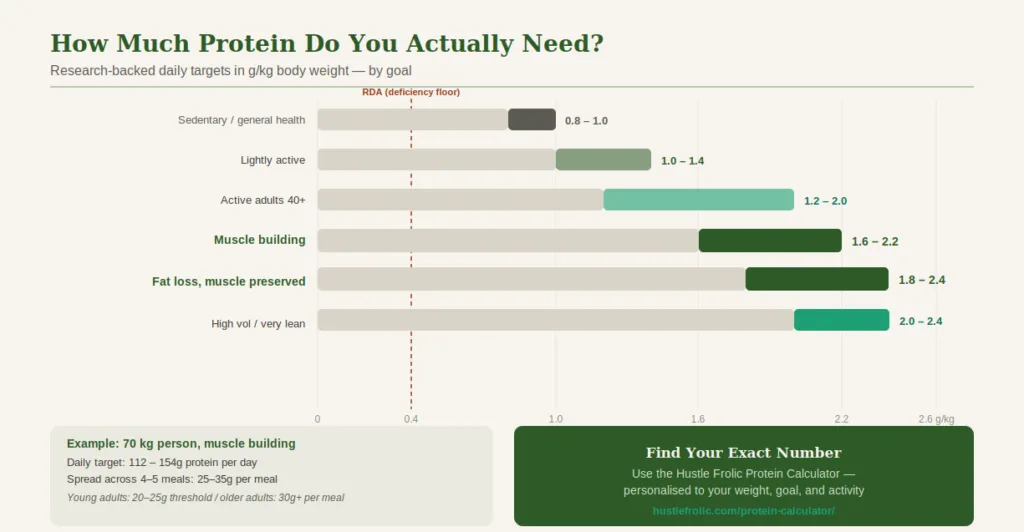
| Goal | Recommended range (g/kg body weight/day) |
|---|---|
| General health, sedentary | 0.8 – 1.0 |
| Lightly active, general fitness | 1.0 – 1.4 |
| Muscle building (training 3-5x/week) | 1.6 – 2.2 |
| Fat loss while preserving muscle | 1.8 – 2.4 |
| Active adults 40+, muscle preservation | 1.2 – 2.0 |
| High volume training or very lean dieters | Up to 2.4 |
Example for a 70 kg person training 4x per week, goal: muscle building: 1.6 × 70 = 112g minimum — 2.2 × 70 = 154g upper range Practical target: 120–140g per day, spread across 4–5 meals of roughly 25–35g each.
Common Protein Myths Worth Permanently Retiring
"Your body can only absorb 20–30g of protein per meal." Not accurate. Your body absorbs nearly all the protein you eat regardless of dose — the 20–25g figure refers specifically to the amount needed to maximally stimulate muscle protein synthesis in a single sitting with fast-digesting proteins, not a hard absorption ceiling beyond which everything is wasted.
"You need protein immediately after your workout or you'll lose gains." The "anabolic window" as a rigid 30-minute post-workout deadline is largely overstated by current research. As covered in our pre-workout nutrition guide, what matters far more is your total daily protein intake and overall diet quality, not the precise minute protein crosses your lips relative to your last set.
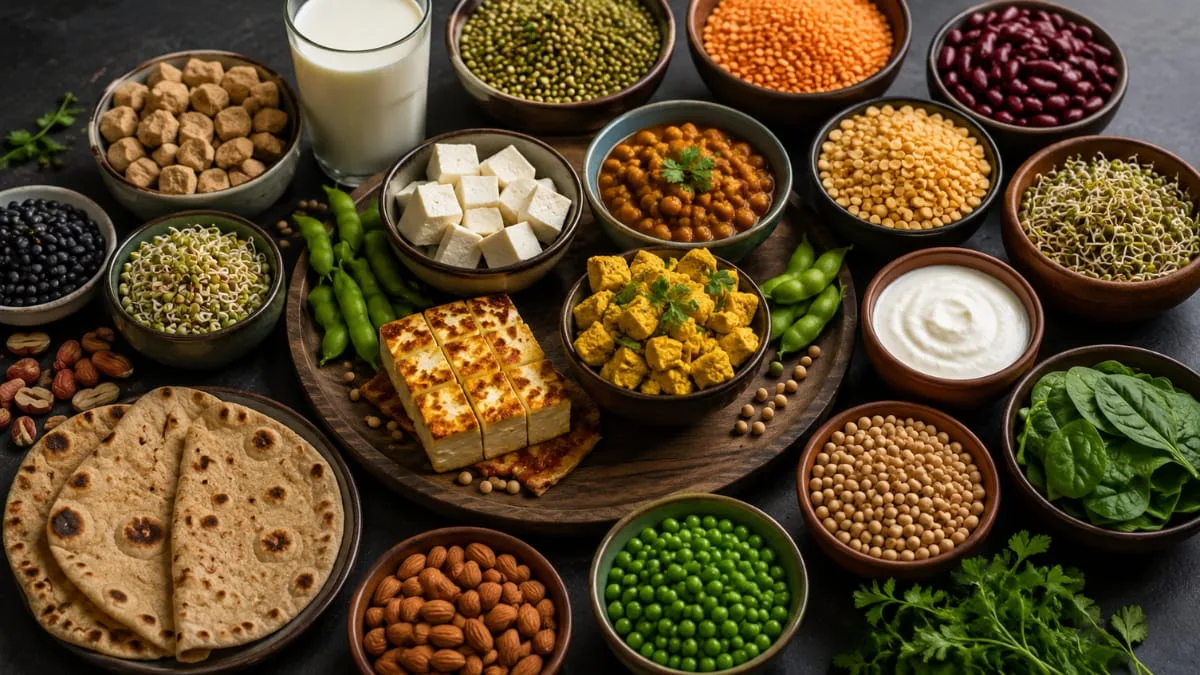
"Plant protein is inferior and vegetarians can't build muscle." A 2019 Stanford study comparing amino acid distributions across animal and plant foods found them nearly identical, and more recent research has found that a well-planned vegan diet supports muscle building equivalently to an omnivore diet when total protein and leucine targets are met. For a practical breakdown of how to hit these targets on an Indian vegetarian diet, our complete guide to high-protein vegetarian foods in India covers exactly this.
"More protein is always better — just eat as much as you can." Beyond roughly 2.4 g/kg/day, the additional muscle-building return on extra protein is genuinely small for most people. The more meaningful question is whether you're consistently hitting the 1.6 g/kg floor — which most active Indians aren't — rather than whether you're maximizing the upper range.
The Bottom Line
The right daily protein target isn't a single universal number — it's a range shaped by your weight, activity, age, and goals. The 0.8 g/kg RDA is a deficiency-prevention floor, not a performance target. For most active people, 1.6 to 2.2 grams per kilogram per day is where the evidence consistently points for muscle building and fat-loss phases, with older adults and those in a calorie deficit benefiting from sitting toward the higher end of that range. Spread that target across your meals rather than concentrating it at dinner, and hit it consistently more days than not — the consistency side of this equation matters just as much as the number itself.
Use the Protein Calculator to get your specific number in under a minute, including a per-meal breakdown that makes the daily target far easier to actually hit.
FAQs: How Much Protein Per Day
Q: Is 0.8 grams of protein per kilogram per day really enough?
A: For preventing protein deficiency in sedentary adults, yes. For supporting active muscle maintenance, body composition, or athletic performance, current evidence consistently suggests this is too low — a floor designed to prevent malnutrition, not optimize performance.
Q: How much protein do I need to build muscle?
A: A well-supported range for muscle building is 1.6 to 2.2 grams per kilogram of body weight per day, based on a 49-study meta-analysis identifying a meaningful breakpoint at approximately 1.62 g/kg, with some evidence suggesting benefits up to 2.4 g/kg for trained individuals with high lean mass.
Q: Should I eat more protein when trying to lose fat?
A: Yes. During a calorie deficit, your protein requirement actually increases compared to maintenance, since the body faces more pressure to break down muscle tissue alongside fat. Research supports 1.8 to 2.4 grams per kilogram as the most protective range during a fat-loss phase.
Q: Does protein per meal timing actually matter?
A: Distribution matters meaningfully for older adults (30g+ per meal to overcome anabolic resistance) and provides modest benefits for younger adults when protein is spread relatively evenly across meals rather than concentrated at one meal. For most people, spreading intake across 3–5 meals of 20–35g each is a practical, well-supported approach.
Q: Is it harmful to eat a lot of protein?
A: Current evidence finds no established harmful upper limit for protein in healthy adults without pre-existing kidney disease. Above roughly 2.4 g/kg/day, returns on muscle building diminish without meaningful additional benefit for most people, but the evidence for health harm in healthy individuals at high intakes is very limited.
Q: How do I calculate my daily protein target quickly?
A: Use the Protein Calculator — it factors in your body weight, activity level, and goal to give you a personalized number in under a minute, including a per-meal breakdown.
Q: Do older adults need more or less protein than younger adults?
A: More, not less. Older adults develop anabolic resistance — a reduced sensitivity of muscle tissue to protein's muscle-building signal — meaning they need more protein both daily and per meal (around 30g per meal vs. 20–25g for younger adults) to achieve the same muscle protein synthesis response.