On this page
- What Muscle Soreness (DOMS) Actually Is
- The DOMS Timeline: What "Normal" Actually Looks Like
- DOMS vs. Injury: The Key Differences
- Understanding Muscle Strain Grades
- Red Flags: When to Stop Guessing and See a Doctor
- What to Do in Each Case
- Why Getting This Right Matters for Long-Term Progress
- The Bottom Line
- FAQs: Muscle Soreness vs Injury
Sore after a workout, but not sure if it's normal or something serious? Learn the key differences between muscle soreness and an actual injury — and when to see a doctor.
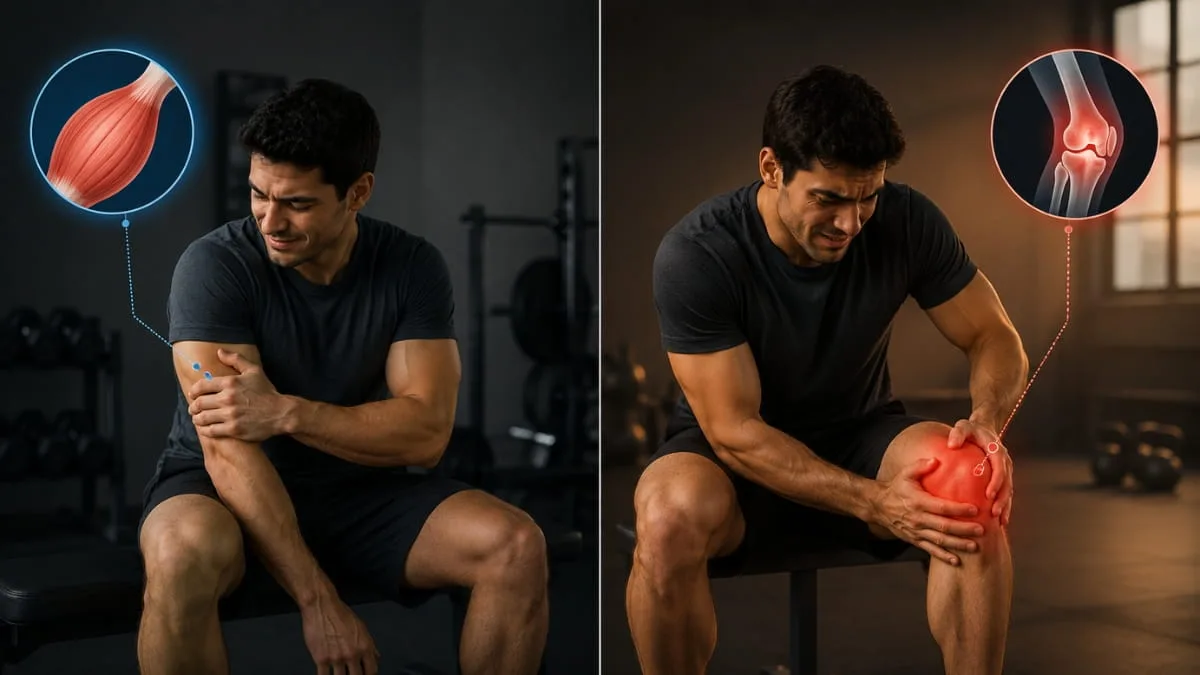
You climbed the stairs this morning and your legs screamed at you. Is that a sign your leg day actually worked, or a sign something's torn? This exact moment of uncertainty trips up beginners and experienced lifters alike — and getting it wrong in either direction has real consequences. Push through an actual injury, and you risk turning a two-week recovery into a two-month one. Treat normal soreness like a catastrophe, and you'll skip workouts you didn't need to skip.
The good news: the difference is genuinely learnable, and it comes down to a handful of clear, checkable signals. Let's break them down.
What Muscle Soreness (DOMS) Actually Is
The dull ache you feel one or two days after a tough workout has a name: Delayed Onset Muscle Soreness, or DOMS. According to Cleveland Clinic, DOMS is pain you feel a few days after intense exercise, and it has a few defining characteristics — it builds gradually over several hours rather than hurting during the workout itself, and it specifically affects the muscles you actually trained.
DOMS is especially common after two kinds of training stress: trying a new exercise or program your muscles aren't used to, and movements involving heavy eccentric contractions — the lengthening phase of a muscle, like the lowering portion of a squat or the downward part of a bicep curl. According to Physiopedia, eccentric contractions cause more structural disruption to muscle and connective tissue than other types of contractions, which is exactly why a new eccentric-heavy leg day often leaves you sorer than a familiar one.
Here's something worth clearing up while we're at it: DOMS has nothing to do with lactic acid. That's one of the most persistent myths in fitness. Lactic acid clears from your muscles within roughly an hour of finishing exercise — long before soreness even begins. Current research points instead to microscopic muscle damage and the inflammatory repair response that follows, with some newer studies even proposing that part of what we feel as DOMS may originate from microdamage to sensory nerve endings within the muscle, not just the muscle fibers themselves.
The DOMS Timeline: What "Normal" Actually Looks Like
One of the most useful things you can know about DOMS is its predictable timeline. Here's roughly what to expect:
- 0–12 hours after training: You may feel fine, or just slightly tight.
- 12–24 hours: Soreness begins to set in and tends to build, often worsening overnight.
- 24–72 hours: Discomfort typically peaks, then gradually starts fading.
- 3–5 days: Most cases of DOMS have fully resolved by this point.
This timeline matters because it gives you a built-in checkpoint. If soreness is following this pattern — building, peaking, then steadily improving — you're almost certainly dealing with ordinary DOMS. If it's not following this pattern at all, that's your first clue something else might be going on.
DOMS vs. Injury: The Key Differences
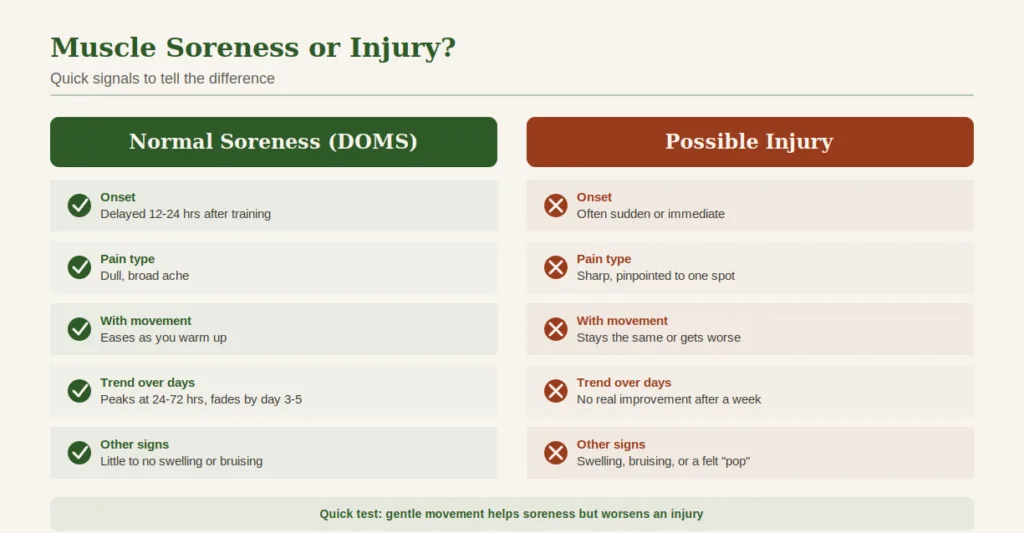
Here's where the practical, checkable signals come in. According to Cedars-Sinai, the clearest distinguishing factor is simple: with DOMS, pain gradually lessens within a few days, but with an actual injury, pain often increases or stays the same rather than improving.
| Signal | Muscle Soreness (DOMS) | Possible Injury |
|---|---|---|
| Onset | Delayed — builds over 12 to 24 hours | Often immediate or sudden |
| Pain type | Dull, broad ache | Sharp, localized, sometimes stabbing |
| Location | Spread across the whole muscle, often both sides evenly | Pinpointed to one specific spot |
| Trend over days | Gradually improves after 24–72 hours | Stays the same or gets worse |
| Response to movement | Eases as you warm up and move | Often worsens with movement or use |
| Swelling/bruising | Rare, usually minimal | Common, especially with moderate-to-severe strains |
| Strength/range of motion | Normal or only mildly reduced | Noticeably reduced or absent |
| Any "pop" or snap felt? | No | Sometimes — a strong signal of a tear |
The single simplest test, repeated across multiple clinical sources, is this: gentle movement helps DOMS but worsens an injury. If light activity and a proper warm-up make the discomfort feel better, that's reassuring. If movement makes it noticeably worse, or if you're guarding the area instinctively, treat it as a possible injury.
Understanding Muscle Strain Grades
If it isn't DOMS, the most common alternative is a muscle strain — sometimes called a "pulled muscle." Doctors classify strains into three grades based on severity, a system outlined by Harvard Health and used widely in sports medicine:
Grade 1 (Mild)
Only a small number of muscle fibers are stretched or torn. The muscle remains tender and painful but typically retains close to normal strength. Pain and tenderness are often delayed until the next day — which is exactly why a mild Grade 1 strain can sometimes be confused with DOMS at first.
Grade 2 (Moderate)
A greater number of fibers are damaged, causing more significant pain and tenderness. Mild swelling, a noticeable loss of strength, and sometimes visible bruising are common. Unlike DOMS, this pain tends to be more localized and doesn't follow the same predictable "peak and fade" pattern.
Grade 3 (Severe)
This is a complete tear — the muscle ruptures all the way through, sometimes accompanied by an audible or felt "popping" sensation as it separates. Grade 3 strains cause complete loss of function in that muscle, along with significant pain, swelling, and visible discoloration. These injuries often require imaging and, in some cases, surgical repair.
Critically, research compiled by HSS notes that Grade 1 injuries can sometimes take just as long to heal as Grade 2 injuries — so even a "mild" classification doesn't mean you should ignore proper recovery time.
Red Flags: When to Stop Guessing and See a Doctor
Some signs are clear enough that you shouldn't try to self-diagnose at all. According to Medical News Today and corroborated across multiple clinical sources, seek medical attention if you notice:
- A popping or snapping sensation at the moment of injury — this is a strong indicator of a muscle tear, not soreness.
- Pain that worsens over time instead of gradually improving.
- Severe swelling that makes it difficult to move the affected area.
- Visible bruising or discoloration, especially appearing within the first 24 hours.
- A noticeable dent, gap, or bulge in the muscle's normal shape — a possible sign of a complete tear.
- Significant loss of strength or range of motion that doesn't improve with gentle movement.
- Pain severe enough that it genuinely worries you, even if you can't pinpoint exactly why.
- Soreness that hasn't improved after 5 to 7 days, or that's still getting worse rather than better.
If you experience any of these, the safest move is a physical exam from a doctor, physical therapist, or sports medicine professional — not pushing through to "test it out" in your next session.
What to Do in Each Case
If It's DOMS
The research is fairly reassuring here: light movement actually helps. According to Cedars-Sinai, continuing mild to moderate activity — like a recovery walk or an easy session targeting a different muscle group — can help lessen DOMS pain and stiffness, while high-intensity efforts on the same muscle group should wait until soreness eases. Staying hydrated, prioritizing sleep, and giving the muscle group roughly 48 hours before training it with similar intensity again are all reasonable, low-risk approaches.
If It's a Suspected Strain
For Grade 1 and Grade 2 strains, the classic RICE protocol (Rest, Ice, Compression, Elevation) remains a standard first step, alongside avoiding any movement that clearly causes pain. Some sports medicine practitioners now favor an updated version sometimes called POLICE (Protection, Optimal Loading, Ice, Compression, Elevation), which emphasizes a more gradual, guided return to movement rather than complete immobilization. Either way, the priority in the first 24 to 48 hours is the same: protect the area, manage swelling, and avoid re-aggravating the tissue.
For anything you suspect might be a Grade 2 or Grade 3 strain — significant swelling, major strength loss, or a felt "pop" — skip the guesswork and get it properly assessed.
Why Getting This Right Matters for Long-Term Progress
Misjudging this distinction in either direction quietly costs people progress. Training through what's actually an unrecognized strain is one of the most common ways a minor injury turns into a long-term setback, since returning to activity before a strain has properly healed significantly increases the risk of re-injury. On the other end, treating completely normal DOMS as a reason to skip a week of training can quietly feed into the same all-or-nothing thinking that derails so much fitness progress — where one cautious day off becomes a much longer, unnecessary break.
Learning to read your body accurately is what lets you train hard with confidence, rather than bouncing between overcaution and overtraining.
The Bottom Line
Most of the discomfort you'll feel after a hard workout is DOMS — a normal, temporary, and even useful sign that your training created a stimulus for adaptation. It builds gradually, peaks within a few days, and steadily improves with light movement. An actual injury tends to behave differently: it's often sudden or sharp, doesn't improve — or actively worsens — with use, and frequently comes with swelling, bruising, or a real loss of strength.
When in doubt, the simplest test still holds up: gentle movement that improves the discomfort points toward DOMS, while movement that makes things worse points toward something that needs proper attention. Learn this distinction once, and you'll spend far less time second-guessing every ache — and far more time training with confidence.
FAQs: Muscle Soreness vs Injury
Q: How long does normal muscle soreness usually last?
A: Typical DOMS peaks around 24 to 72 hours after exercise and resolves within roughly 3 to 5 days. If soreness lasts much longer than this or keeps getting worse instead of better, it's worth treating as a possible injury rather than ordinary soreness.
Q: Is muscle soreness a sign that my workout was effective?
A: Soreness can indicate that your muscles experienced an unfamiliar or more intense stimulus than they're used to, but it isn't a reliable measure of workout quality. Plenty of effective, well-adapted training sessions produce little to no soreness at all.
Q: What's the fastest way to tell soreness apart from a strain?
A: Pay attention to how the discomfort responds to gentle movement. Soreness typically eases as you warm up and move around, while an actual strain or injury tends to feel the same or worse with movement, especially under load.
Q: Should I work out again if I'm still sore from the last session?
A: Light to moderate activity is usually fine and can even help reduce DOMS, but high-intensity training on the same muscle group should generally wait until soreness has noticeably eased, typically around 48 hours after the initial session.
Q: Does popping or cracking during exercise always mean an injury?
A: A popping or snapping sensation specifically at the moment of injury is a recognized warning sign of a muscle tear and should be evaluated by a medical professional. This is different from ordinary joint cracking that isn't accompanied by pain or loss of function.
Q: Can a mild strain feel exactly like normal soreness at first?
A: Yes, which is part of what makes this tricky. A Grade 1 strain can have delayed pain similar to DOMS, but it typically stays localized to one specific spot rather than spreading evenly, and it doesn't reliably improve over the next few days the way DOMS does.
Q: When should I actually see a doctor instead of waiting it out?
A: See a doctor if you notice a popping sensation at the time of injury, pain that worsens rather than improves, significant swelling or bruising, a visible dent or bulge in the muscle, major loss of strength, or soreness that hasn't improved after about a week.
Note: This article is for general informational purposes and isn't a substitute for professional medical advice. If you're uncertain whether you're dealing with soreness or an injury, please consult a doctor, physical therapist, or qualified sports medicine professional.