On this page
- First, What Kind of Recovery Are You Actually Looking At?
- Path 1: Non-Surgical Recovery Timeline (No Operation)
- Path 2: Meniscectomy Recovery Timeline (Partial Removal)
- Path 3: Meniscus Repair Recovery Timeline (Surgical Repair)
- Factors That Can Speed Up or Slow Down Your Recovery
- Warning Signs During Recovery: When to Call Your Doctor
- What This Recovery Taught Me About Patience
- The Bottom Line
- FAQs: Meniscus Tear Recovery
Just diagnosed with a meniscus tear? Get a clear, week-by-week breakdown of what recovery actually looks like — whether you're treating it conservatively or recovering from surgery.
The knee twists, there's a pop or a catch, and suddenly stairs feel impossible. If you've just been told you have a meniscus tear, the most common question isn't "what is this" — it's "how long until I'm normal again." It's a question I've sat with personally too, having gone through my own meniscus recovery, and I know how much the uncertainty can weigh on you almost as much as the injury itself.
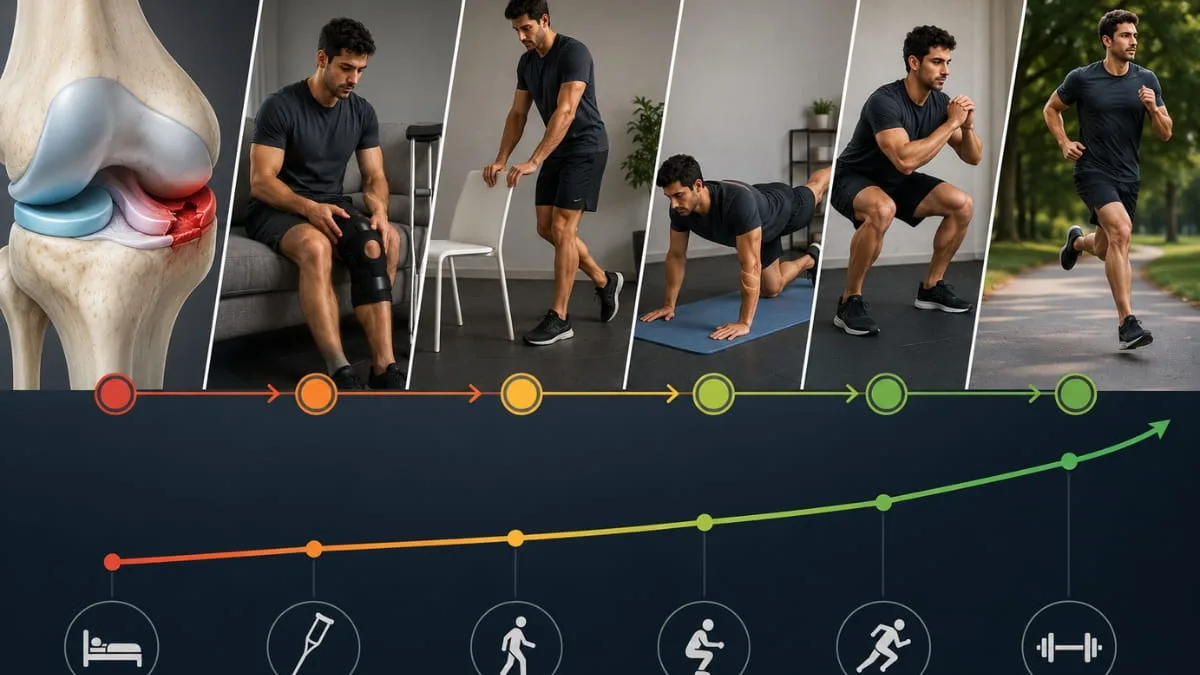
The honest answer is: it depends — on the tear, on whether you need surgery, and on how well you stick to rehab. But "it depends" isn't very useful when you're staring down weeks of recovery. So let's break this down into an actual week-by-week picture, based on current orthopedic guidance, so you know roughly what to expect at each stage.
First, What Kind of Recovery Are You Actually Looking At?
Before any timeline makes sense, you need to know which path you're on, because they genuinely look very different:
- Non-surgical (conservative) recovery — rest, physiotherapy, and time, with no operation at all.
- Meniscectomy recovery — surgical removal of the damaged portion of the meniscus.
- Meniscus repair recovery — surgical stitching/repair of the torn meniscus, preserving the tissue.
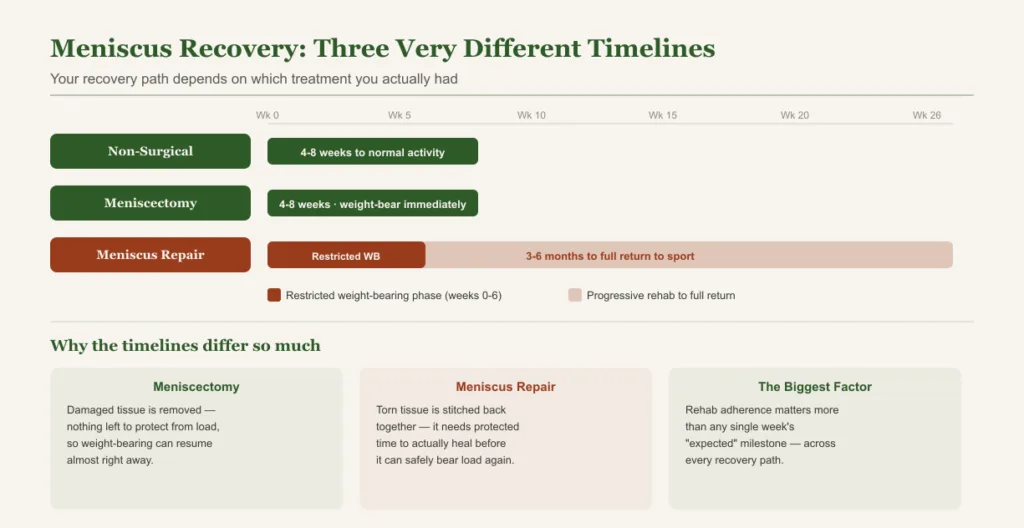
These aren't interchangeable, and mixing up their timelines is one of the most common sources of confusion online. Generally speaking, non-surgical treatment and meniscectomy recovery run faster — typically 4 to 8 weeks — while meniscus repair recovery is considerably longer, generally 3 to 6 months before a full return to demanding activity.
Why the big difference? It comes down to biology. The meniscus has three zones based on blood supply: the outer red zone (good blood flow, heals more readily), the middle red-white zone, and the inner white zone (almost no blood supply, very limited healing capacity). Tears in the red zone are realistic candidates for repair and natural healing; tears deep in the white zone often can't be repaired at all and may require partial removal instead. Your surgeon's choice between repair and meniscectomy is largely dictated by exactly where your tear sits.
Path 1: Non-Surgical Recovery Timeline (No Operation)
If your tear is small, stable, and located in a well-vascularized zone, many surgeons will recommend trying conservative management first — and the research increasingly supports this. Multiple cost-effectiveness studies have found that physical therapy is often more cost-effective than surgery for degenerative meniscus tears, and that physical therapy followed by delayed surgery, if needed later, frequently outperforms jumping straight to an operation.
Week 1: Focus is entirely on pain and swelling control. Rest, ice, compression, elevation, and avoiding anything that loads the knee. You may use crutches if weight-bearing is painful.
Weeks 2–6: This is the heart of conservative rehab. As swelling decreases, physiotherapy becomes the main driver of recovery — gentle range-of-motion work, then progressive strengthening of the quadriceps, hamstrings, and hip muscles that support the knee. Most patients steadily progress toward full weight-bearing during this window.
Weeks 6–8: Most people managing a meniscus tear without surgery are largely back to normal daily activity within roughly 4 to 8 weeks, assuming consistent rehab and no complications.
Beyond 3 months: If pain, locking, or swelling haven't meaningfully improved by the 3-to-6-month mark, specialists generally recommend a multidisciplinary review, since surgery may become the better option at that point.
Path 2: Meniscectomy Recovery Timeline (Partial Removal)
A meniscectomy removes the damaged portion of the meniscus rather than repairing it. Because there's no repaired tissue that needs protecting from load, this recovery moves noticeably faster than a repair.
Days 1–3: Pain and swelling typically peak within 48 to 72 hours after surgery. Movement starts almost immediately — ankle pumps to support circulation, along with gentle quad activation exercises.
Week 1–2: Unlike repair surgery, meniscectomy patients typically bear weight as tolerated right away, often using crutches only for comfort rather than necessity. Range-of-motion work is more aggressive too — many protocols aim for roughly 90 degrees of knee flexion by week 2.
Weeks 3–6: Strengthening ramps up substantially. Most patients in this category return to normal daily activities within this window, and many return to lower-impact sports.
Weeks 6–8+: Return to higher-impact sport or heavy training is generally cleared somewhere in this range, depending on strength testing and surgeon clearance — though this varies by individual case and activity demands.
Path 3: Meniscus Repair Recovery Timeline (Surgical Repair)
This is the slowest, most protected pathway — and it's the one I went through myself. The logic is straightforward: repaired tissue needs time and protection to actually heal, and loading it too early can compromise the repair itself.
Weeks 0–2 (Immediate post-op): The priority is protecting the repair. Many protocols call for keeping the knee straight and elevated, avoiding active bending, and avoiding any pivoting on the surgical leg entirely during this phase. You'll likely be on crutches, often non-weight-bearing or only toe-touch weight-bearing.
Weeks 2–6: Weight-bearing restrictions typically continue, with most repair protocols keeping patients non-weight-bearing or toe-touch weight-bearing for 4 to 6 weeks depending on the complexity of the tear and the specific surgical technique used. Range of motion is often restricted to a protected arc (commonly limited well short of full flexion) to avoid stressing the posterior horn of the meniscus, where compressive forces are highest. Gentle, protected strengthening — straight leg raises, quad sets — typically begins here, often on both legs to prevent the uninjured side from compensating and weakening.
Weeks 6–12: This is usually when full weight-bearing is finally cleared. Strength training becomes more structured, and exercises progress from simple, protective movements to more functional ones. Some modern post-surgical protocols introduce blood flow restriction (BFR) training around this period specifically to combat the muscle atrophy that builds up during the restricted early weeks.
Months 3–4: Rehab shifts toward sport-specific and functional movement — light jogging may begin once a patient can tolerate a set pace and distance on a treadmill, progressing gradually toward agility work.
Months 4–6+: Return to full sport or high-demand activity is typically not cleared until this point at the earliest, and often later. It's worth being clear-eyed here: even after formal physical therapy ends around 3 to 4 months, many surgeons emphasize that full recovery and strengthening continues for many months beyond that — sometimes beyond a year post-surgery, and ongoing diligence with strength work matters for the long-term outcome.
A Note on Weight-Bearing: The Science Is Evolving
It's worth knowing that the traditional, highly restrictive weight-bearing rules after meniscus repair are being actively re-examined. Several studies comparing restricted versus more accelerated weight-bearing and range-of-motion protocols after meniscal repair have found comparable healing outcomes between the two approaches, suggesting some of the older, more conservative protocols may be more restrictive than strictly necessary for certain tear types. That said, protocols still vary considerably between surgeons and institutions — which is exactly why following your own surgeon's specific guidance matters more than any general timeline, including this one.
Factors That Can Speed Up or Slow Down Your Recovery
- Tear location: Tears in the well-vascularized outer "red zone" generally heal faster than those in the avascular inner "white zone."
- Tear pattern: Some tear types, like radial tears that extend in multiple directions, carry additional complexity and risk that can affect both treatment choice and recovery pace.
- Age and activity level: Younger, more active individuals often recover faster; older adults or those with existing arthritis may take longer.
- Rehab adherence: This is the factor most within your control. Consistency with prescribed exercises has a direct, significant impact on outcomes — this is true across virtually every recovery protocol reviewed.
- Associated injuries: A meniscus tear combined with an ACL injury follows a different, generally longer timeline than an isolated meniscus injury.
Warning Signs During Recovery: When to Call Your Doctor
Regardless of which path you're on, certain symptoms during recovery warrant an immediate call to your surgeon or physical therapist rather than waiting it out:
- Fever, chills, or excessive drainage from a surgical incision
- Significant calf swelling, tenderness, or warmth (a possible sign of blood clot)
- Pain that is uncontrolled by prescribed medication
- A locked knee that won't move, or a sudden return of catching/locking sensations
- Swelling or pain that's clearly worsening rather than improving, well past the expected peak window
These aren't meant to cause alarm — most recoveries proceed without complications — but they're the specific signals that mean "call your care team now" rather than "wait and see."
What This Recovery Taught Me About Patience
I won't pretend the timeline above tells the whole story, because it doesn't capture the part that's actually hardest: the mental side of watching your strength and mobility disappear for months while everyone around you keeps training. There were stretches during my own recovery where the physical progress felt achingly slow, and the real work was simply not giving up on the process before the biology had caught up.
If there's one thing I'd want anyone reading this mid-recovery to hear, it's that the week-by-week milestones are real, but they're also averages — not a verdict on how well you're doing if your knee takes a bit longer at any given stage. Consistency with rehab, patience with the timeline, and staying in close contact with your care team matter more than hitting any single week's "expected" benchmark exactly on schedule.
The Bottom Line
Meniscus recovery timelines vary enormously depending on whether you're managing the tear conservatively, recovering from a meniscectomy, or recovering from a surgical repair — ranging from roughly 4–8 weeks on the faster end to 4–6 months or more for a full repair recovery. What stays consistent across all three paths is this: rehab adherence is the single biggest factor within your control, and watching for genuine warning signs matters more than obsessing over hitting a specific week's milestone precisely on schedule.
If you're in the middle of this right now, be patient with your knee. The timeline is real, but so is the variation around it — and showing up for the unglamorous, repetitive rehab work each week is what actually gets you back.
FAQs: Meniscus Tear Recovery
Q: How long does a meniscus tear take to heal without surgery?
A: Most people managing a meniscus tear conservatively, through rest and physiotherapy, see meaningful recovery within roughly 4 to 8 weeks. If symptoms like pain, locking, or swelling persist beyond 3 to 6 months without improvement, a specialist review for possible surgery is typically recommended.
Q: What's the difference between meniscus repair and meniscectomy recovery?
A: Meniscectomy removes the damaged tissue and generally allows much faster recovery, often 4 to 6 weeks, since there's no repaired tissue to protect. Meniscus repair preserves the tissue through surgical stitching but requires a much longer, more protected recovery, typically 3 to 6 months, since the repair needs time to heal under restricted load.
Q: When can I put weight on my knee after meniscus surgery?
A: This depends heavily on which procedure you had. Meniscectomy patients can often bear weight almost immediately, as tolerated. Meniscus repair patients are typically kept non-weight-bearing or toe-touch weight-bearing for around 4 to 6 weeks, though this varies by surgeon and tear complexity.
Q: Can a meniscus tear heal on its own without any treatment?
A: Some small, stable tears in the well-vascularized outer zone of the meniscus can improve with rest and physical therapy alone, without surgery. However, there is limited long-term data on truly untreated tears, which is why a proper diagnosis and a structured plan, even a conservative one, matters more than waiting it out alone.
Q: When can I return to sports after a meniscus tear?
A: For non-surgical or meniscectomy recovery, a return to sport is often possible within 6 to 8 weeks, depending on strength testing. For meniscus repair, return to sport is generally not cleared until 4 to 6 months at the earliest, since the priority is protecting the healing tissue from re-injury.
Q: What are signs that my meniscus recovery isn't going well?
A: Pain or swelling that worsens rather than improves, a knee that locks or catches, fever or signs of infection at a surgical site, or significant calf swelling or tenderness are all signals to contact your doctor promptly rather than waiting for your next scheduled appointment.
Q: Does age affect how fast a meniscus tear heals?
A: Yes. Younger, more active individuals tend to recover faster, while older adults or those with existing knee arthritis often experience longer recovery timelines. Age can also influence whether a tear is even a good candidate for repair, since tissue quality and healing capacity tend to decline over time.
Note: This article is for general informational purposes based on current orthopedic and physical therapy guidance, and reflects both published research and personal recovery experience. It is not a substitute for professional medical advice. Recovery protocols vary by surgeon, tear type, and individual case — always follow your own surgeon's and physical therapist's specific guidance over any general timeline.