On this page
- The Core Principle: Timing Flexibility Beats Rigid Rules
- Why Carbs Are the Real Energy Driver
- Why Protein Still Belongs in the Meal
- Where Fat Fits — and Why Timing Matters More Than Amount
- The Caffeine Question: A Genuinely Useful, Well-Researched Tool
- Putting It Together: Sample Pre-Workout Meals by Timing
- How This Fits Into a Fat Loss Phase Specifically
- The Bottom Line
- FAQs: Pre-Workout Meals for Energy and Fat Loss
Wondering what to eat before training to feel energized without working against your fat loss goals? Here's what the research actually supports — not another generic "eat a banana" tip.
Pre-workout nutrition advice tends to fall into two unhelpful extremes: either an oversimplified "just eat a banana" tip that ignores your actual training and goals, or an overcomplicated supplement stack that promises more than the science supports. The real answer sits in between, and it's more specific and more useful than either extreme — built around timing, macronutrient roles, and a few well-studied tools that genuinely help with both energy and fat loss simultaneously.
Here's what the research actually says.
The Core Principle: Timing Flexibility Beats Rigid Rules
One of the most useful, evidence-backed shifts in recent sports nutrition research is the move away from the idea of a strict "anabolic window" that pre-workout nutrition has to hit perfectly. A 2025 meta-analysis examining whether protein consumed before versus after training meaningfully changed muscle and strength outcomes found essentially no meaningful difference in lean mass between the two timings. What mattered far more was total daily protein and calorie intake, not the precise minute-by-minute timing around your workout.
This is genuinely good news, because it means the "best" pre-workout meal depends heavily on how much time you actually have — not on hitting one rigid formula. Current nutrition guidance generally breaks this down into three practical windows:
- 2 to 4 hours before training: Time for a complete, balanced meal with carbs, protein, and some fat.
- 1 to 1.5 hours before training: A smaller meal focused mainly on carbs and protein, with fat kept lower to avoid digestive discomfort.
- Less than 45 minutes before training: Keep it simple — small amounts of fast-digesting carbs, low in fat and fiber, to avoid training on a heavy stomach.
A useful rule worth remembering: a small amount of fast-digesting carbohydrate eaten close to training is dramatically better for performance than training completely unfed, even if it's not the "ideal" macronutrient mix.
Why Carbs Are the Real Energy Driver
If your main goal before training is genuine energy and performance, carbohydrates do most of the heavy lifting, not protein. Research comparing pre-exercise ingestion of carbohydrate, protein, and no nutrition at all found that carbohydrate ingestion specifically increased carbohydrate oxidation — meaning more readily available fuel for your working muscles — in a way that protein consumption simply didn't replicate. Protein still matters for the meal as a whole, but for the specific feeling of having usable energy during a session, carbs are doing most of the work.
This matters for fat loss too, somewhat counterintuitively: when you're well-fueled and able to train at a higher intensity, you typically burn more total calories during the session and protect your strength output, both of which support fat loss far more effectively over time than training in a depleted, low-energy state ever could.
Why Protein Still Belongs in the Meal
Even though protein isn't the primary energy source for training, including it pre-workout still serves a real purpose. Protein's role here is less about fueling the session itself and more about supporting muscle protein synthesis and recovery afterward, and a small amount of research has found a modest strength benefit specifically from pre-workout (versus post-workout) protein timing, even if the effect on overall lean mass is minimal.
Practically, this means a pre-workout meal built around carbs alone misses an opportunity, while one built around protein alone often leaves you under-fueled for the session itself. The combination is what the research consistently supports.
Where Fat Fits — and Why Timing Matters More Than Amount
Fat isn't the enemy of a pre-workout meal, but it is the macronutrient most sensitive to timing. Because fat digests slowly, a meal that's too high in fat too close to training can cause sluggishness or digestive discomfort exactly when you want to feel sharp and energized. The fix isn't to avoid fat — it's to include it in your larger, earlier pre-workout meals (the 2-to-4-hour window) and minimize it in anything eaten closer to training time.
The Caffeine Question: A Genuinely Useful, Well-Researched Tool
This is where the "energy and fat loss" combination in this post's title gets real, specific scientific support — caffeine is one of the most thoroughly studied pre-workout tools, and the research is unusually precise about both dose and timing.
A systematic review and meta-analysis examining caffeine's effect on fat oxidation during exercise found that caffeine significantly increased the rate of fat being used for fuel during submaximal aerobic exercise, with a clear dose-response relationship — meaning more than roughly 3 mg per kilogram of body weight was needed to see a statistically significant effect. A separate, more recent 2026 study refined this further, testing caffeine doses of 3, 5, and 9 mg/kg specifically during fat-oxidation-focused exercise, and found that the fat-oxidizing effect increased from 3 to 5 mg/kg but provided no additional benefit at 9 mg/kg — while also coming with a higher risk of side effects at that higher dose.
For a person weighing around 70 kilograms (roughly 154 lbs), this translates to a practical range of about 210 to 350 mg of caffeine, taken roughly 30 to 60 minutes before training — notably, this is also the dose range most commonly used in performance research more broadly, suggesting caffeine's fat-oxidation and performance benefits overlap at similar dosing.
It's worth being clear about what this actually means for fat loss: increased fat oxidation during a single workout is a real, measurable physiological effect, but it's a modest contributor compared to your overall calorie balance across the week. Caffeine is genuinely useful here primarily because it supports the energy and performance side of the equation — letting you train harder and more consistently — with the fat-oxidation benefit functioning as a smaller, supportive bonus on top.
Putting It Together: Sample Pre-Workout Meals by Timing
Based on the research above, here's what a well-constructed pre-workout meal looks like depending on how much time you have:
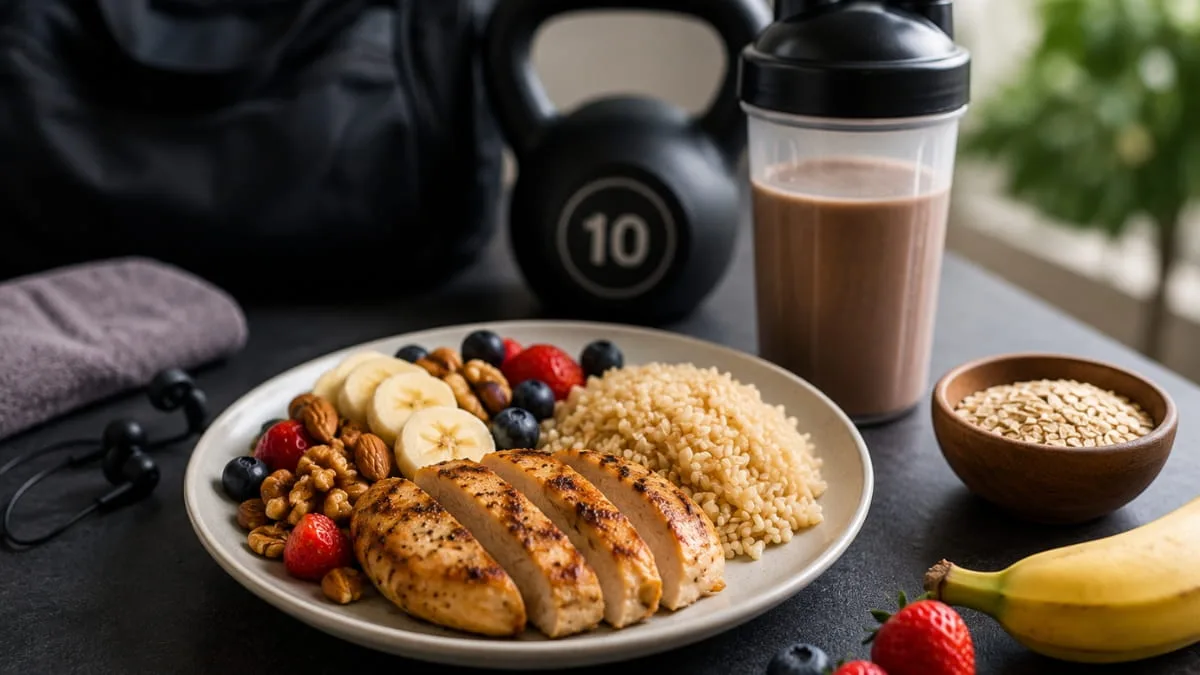
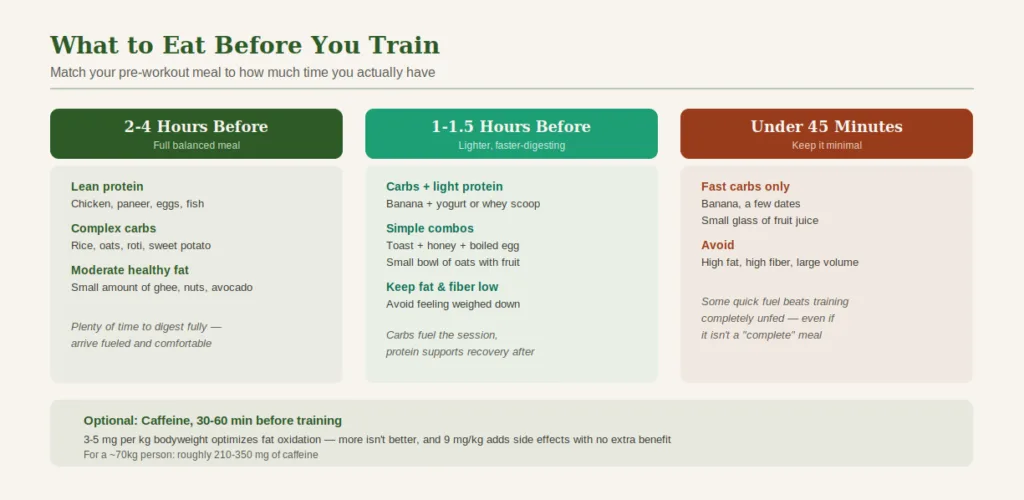
2 to 4 hours before training: A balanced plate with a lean protein source (chicken, paneer, eggs, fish), a complex carbohydrate (rice, oats, roti, sweet potato), and a moderate amount of healthy fat (a small amount of ghee, nuts, or avocado). This gives your body plenty of time to digest fully and arrive at your workout fueled and comfortable.
1 to 1.5 hours before training: Something lighter and faster-digesting — a banana with a small amount of yogurt or a scoop of whey, a slice of toast with honey and a boiled egg, or a small bowl of oats with fruit. Keep fat and fiber on the lower side here to avoid feeling weighed down.
Less than 45 minutes before training: Keep it minimal — a banana, a few dates, or a small glass of fruit juice. The goal here is simply having some fast-digesting fuel available, not building a complete meal.
Optional, evidence-supported addition: Coffee or a caffeine source roughly 30 to 60 minutes before training, dosed in the 3 to 5 mg/kg range discussed above, for those who tolerate caffeine well and don't have contraindications like anxiety, sleep issues, or heart conditions.
How This Fits Into a Fat Loss Phase Specifically
If you're training in a calorie deficit, pre-workout nutrition deserves a slightly different emphasis than during maintenance or a surplus. Since total daily calories matter more than precise timing, your pre-workout meal doesn't need to be large — it needs to be strategically placed within your daily calorie allowance so you're genuinely fueled for your hardest training session, rather than saving most of your calories for later in the day and training depleted.
This connects directly to a broader point we've made before: adequate protein intake during a deficit matters enormously for preserving muscle, and a well-timed pre-workout meal is one practical way to make sure that protein, along with enough carbohydrate to actually perform, doesn't get crowded out by an overly restrictive eating pattern earlier in the day.
The Bottom Line
The best pre-workout meal isn't a single magic combination — it's a framework: prioritize carbohydrates for genuine energy, include a moderate amount of protein, keep fat lower the closer you get to training time, and consider caffeine in the 3-to-5 mg/kg range as a well-researched, optional tool for both performance and modest fat-oxidation support. None of this requires rigid timing or expensive supplements. It requires understanding what each macronutrient is actually doing for you, and building a simple meal around that, scaled to however much time you genuinely have before you train.
FAQs: Pre-Workout Meals for Energy and Fat Loss
Q: What should I eat before a workout for energy?
A: Carbohydrates are the primary driver of pre-workout energy, since they directly fuel the muscles you're about to use. A meal or snack built around easily digestible carbs, combined with a moderate amount of protein, generally works best, with timing adjusted based on how long you have before training.
Q: Is there an "anabolic window" I need to hit before training?
A: Current research suggests this concept has been overstated. A 2025 meta-analysis found no meaningful difference in lean mass outcomes between protein consumed before versus after training, indicating that total daily protein intake matters far more than precise pre-workout timing.
Q: Does eating before a workout actually help with fat loss?
A: Indirectly, yes. Being properly fueled allows you to train at a higher intensity and maintain strength output, both of which support greater total calorie expenditure and better long-term fat loss results than training in a depleted, low-energy state.
Q: How much caffeine should I take before a workout for fat burning?
A: Research suggests a dose of roughly 3 to 5 mg per kilogram of body weight, taken 30 to 60 minutes before training, appears to optimize the fat-oxidation benefit of caffeine, with doses beyond this range providing no additional benefit while increasing the risk of side effects.
Q: What should I eat if I only have 30 minutes before my workout?
A: Keep it simple and fast-digesting: a banana, a few dates, or a small glass of fruit juice. A small amount of quick carbohydrate is significantly better for performance than training on an empty stomach, even if it isn't a complete, balanced meal.
Q: Should I avoid fat before working out?
A: Not entirely, but timing matters. Fat digests slowly, so it's best included in larger meals eaten 2 to 4 hours before training, and minimized in anything eaten within an hour or so of your workout to avoid sluggishness or digestive discomfort.
Q: Is it better to train fasted for fat loss?
A: Not necessarily. While fasted training can increase fat oxidation during that specific session, it often comes at the cost of training intensity and total performance, which can reduce overall calorie expenditure and strength output, both of which matter more for sustained fat loss than the fasted state itself.