On this page
- Is it safe to exercise in air pollution? What the research says
- The AQI decision chart: what workout to do at each level
- The best time of day to exercise in Delhi's winter
- Training indoors: cleaner air, two workouts and a weekly plan
- Should you wear an N95 mask when you exercise?
- Smog season myths vs facts
- Warning signs: when to stop
- Frequently asked questions
- Get the free Smog Season Training Guide
Every winter, Delhi loses about three months of training. Once the AQI climbs past 300, most people do one of two things: they keep running at 6 am as if nothing has changed, or they stop exercising completely until spring.
Both are mistakes. Research shows that exercise still lowers your health risks in polluted cities, but pollution shrinks how much it helps. So the real question isn't whether to train this winter. It's where, when and how hard.
This guide gives you the system I use with my coaching clients in Delhi NCR: an AQI-based decision chart, the best times of day to train, how to make indoor air cleaner, two indoor workouts, and what actually works with masks.
Want it as a printable PDF? Download the free 12-page Smog Season Training Guide with a 4-week AQI and training log.
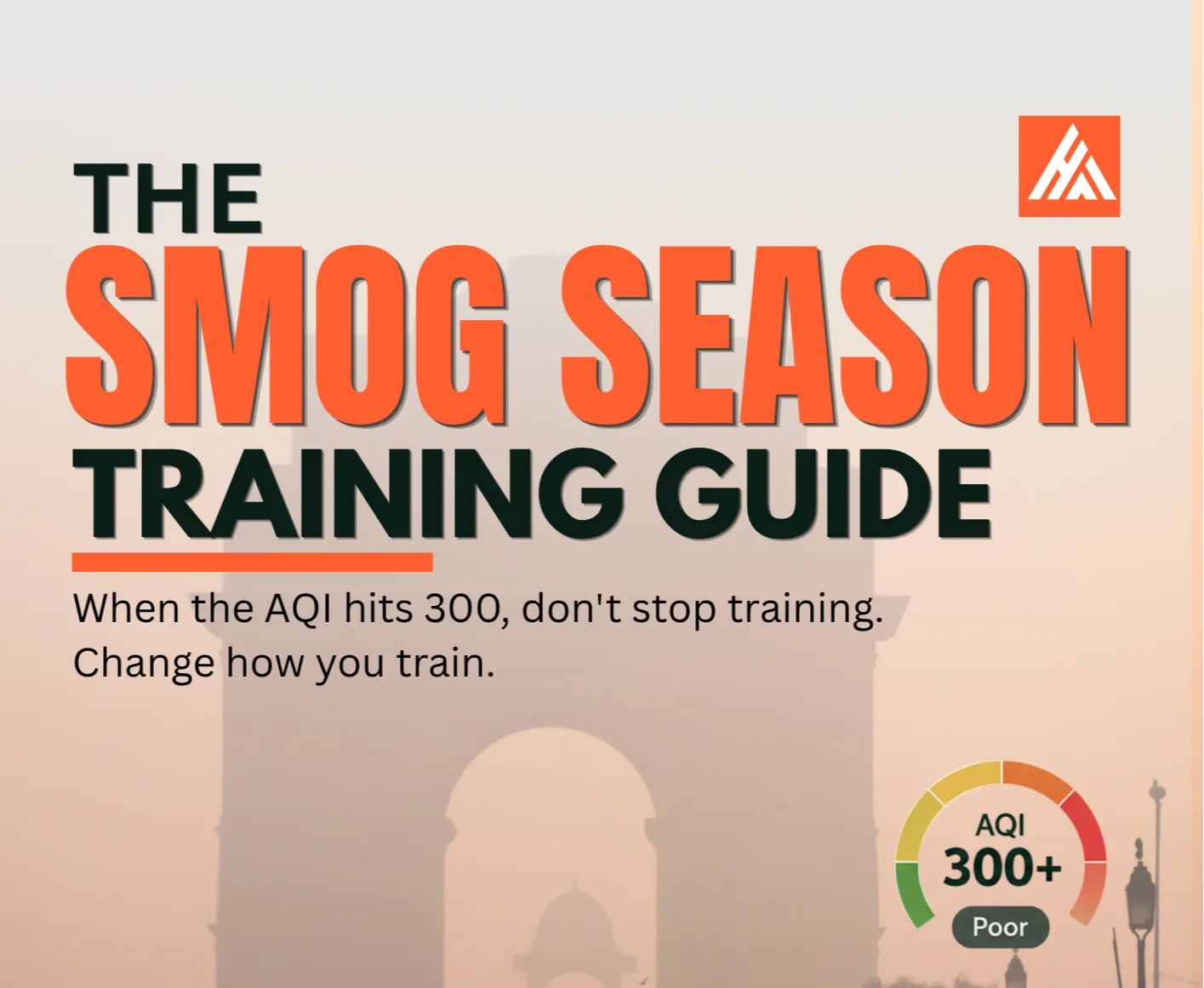
Free download
The Smog Season Training Guide
When the AQI hits 300, don't stop training. Change how you train.
PDF · 344.5 KB
Is it safe to exercise in air pollution? What the research says
Yes, for most healthy adults, but with changes. Exercise still lowers your risk in polluted air, just by less.
A 2025 systematic review and pooled analysis in BMC Medicine combined cohort studies covering about 1.5 million adults followed for a median of around 12 years. People who met physical activity recommendations had roughly a 30% lower risk of death where long-term PM2.5 was below 25 µg/m³. Where PM2.5 was above 25 µg/m³, the same activity lowered risk by about 12–15% (summary). Activity was still beneficial at higher pollution levels; the benefit was smaller, not gone.
Why this matters in Delhi
That 25 µg/m³ line is lower than you might think. Under India's National Air Quality Index, a "Satisfactory" day already has PM2.5 of 31–60 µg/m³.
AQI category | AQI | PM2.5, 24-hr (µg/m³) | Health impact (CPCB) |
|---|---|---|---|
Good | 0–50 | 0–30 | Minimal impact |
Satisfactory | 51–100 | 31–60 | Minor breathing discomfort for sensitive people |
Moderate | 101–200 | 61–90 | Breathing discomfort for people with lung or heart disease, children and older adults |
Poor | 201–300 | 91–120 | Breathing discomfort for most people on prolonged exposure |
Very Poor | 301–400 | 121–250 | Respiratory illness on prolonged exposure |
Severe | 401–500 | 250+ | Affects healthy people; serious impact on those with existing disease |
So during a Delhi winter, you are almost always training above that threshold. The goal is to reduce how much polluted air you breathe while you train, without losing the habit.
The AQI decision chart: what workout to do at each level
Check the live AQI for your nearest monitoring station every morning, using the CPCB's SAMEER app or a site like IQAir. Then match your workout to the band.
AQI | What to do |
|---|---|
0–100 (Good, Satisfactory) | Train as normal. Outdoor runs, cycling and sports are fine. |
101–200 (Moderate) | Easy outdoor runs and walks, away from busy roads. Move intervals, tempo runs and HIIT indoors. If you have asthma or heart disease, go indoors. |
201–300 (Poor) | Move cardio indoors. Outdoors, only short, easy walks with a well-fitted N95. A good week to focus on strength. |
301–400 (Very Poor) | Train everything indoors, ideally in a room with an air purifier. Without one, keep cardio moderate. |
401–500 (Severe) | Strength and mobility indoors at lower intensity. Skip HIIT unless the indoor air is filtered. Rest if you have any symptoms. |
The logic is simple. The harder you breathe, the more air (and the more particles) you pull into your lungs. So as the AQI rises, the hard breathing moves indoors first. Strength training is your best friend in smog season, because it needs far less heavy breathing than cardio.
This chart is a coaching guideline, not a medical standard. If you have asthma, COPD or heart disease, or are pregnant, follow your doctor's thresholds, which may be stricter.
The best time of day to exercise in Delhi's winter
The 6 am run is often the worst choice in winter. On cold, still nights, a shallow layer of air traps pollution close to the ground.
A study of PM2.5 across Delhi from 2018 to 2022 found two daily peaks: 8–10 am, driven by traffic and road dust, and 8 pm to midnight, when the boundary layer is stable and the air doesn't mix.
Better window: roughly late morning to mid-afternoon (about 11 am to 4 pm), when the sun warms the ground and pollution mixes upward. A lunchtime walk beats a dawn run in December.
Windows to avoid outdoors: 8–10 am and 8 pm to midnight, and anywhere next to a main road at any time.
Best days: after rain or on windy days, which are often the cleanest of the week.
Can't change your workout time? Change the place instead: do your early session indoors and save outdoor walks for a lunch break or weekend afternoons. Real conditions vary with wind, rain and crop burning, so always check the live AQI.
Training indoors: cleaner air, two workouts and a weekly plan
Indoors isn't automatically clean air
Smog gets inside through doors, windows and gaps, so indoor air in Delhi homes can be close to outdoor levels. Before you train inside:
Use an air purifier with a true HEPA filter, sized for the room (check its CADR, or clean air delivery rate, against the room's size).
Run it with doors and windows closed for 30–60 minutes before your session.
Air the room out during the cleaner afternoon window, not at night.
Don't burn incense, mosquito coils, candles or diyas in the same room.
At the gym, ask whether purifiers run on the floor and whether doors stay closed to the road.
Workout A: 25-minute indoor cardio (no treadmill)
Warm up for 3 minutes. Then do 4 rounds, with 45 seconds of work and 15 seconds to switch:
Jumping jacks (lower-impact: step jacks)
Step-ups on a stair or sturdy box
Shadow boxing
Skater hops (lower-impact: side step and touch)
Mountain climbers (easier: hands on a sofa)
Aim for "hard, but you could still talk in short sentences."
Workout B: 30-minute home strength
Do 3 rounds with 60–90 seconds of rest between rounds. No dumbbells? Use a backpack filled with books or water bottles.
Exercise | Reps |
|---|---|
Goblet squat | 10–12 |
Push-ups | 8–15 |
One-arm row | 10–12 per side |
Romanian deadlift | 10–12 |
Split squat | 8–10 per side |
Dead bug | 8 per side |
How to plan a smog-season week
Check the 3-day AQI forecast on Sunday. Put outdoor sessions on the cleanest days and keep the rest indoors. If you can only do two sessions in a bad week, make both of them strength. Keep cardio at a comfortable, steady effort and save personal-best attempts for spring. And keep your steps above 7,000 a day by walking during calls, taking the stairs, or walking in a mall on weekend afternoons.
Should you wear an N95 mask when you exercise?
For commuting and walking, yes. For hard training, move the session indoors instead.
Well-fitted respirator masks can make a real difference. In a Beijing study, people who wore a high-efficiency mask on a city walk had lower blood pressure and better heart-rate variability than when they walked without one. But testing of commercial masks in Beijing found that leaks around the edges made a big difference to how well they protected people in practice.
Use an N95 or FFP2 mask for commutes, walks and errands on Poor-or-worse days.
Get a tight seal: pinch the nose clip and check for air escaping around the edges. Beards break the seal.
Skip cloth and surgical masks for smog. They don't filter fine particles well.
Don't do hard running or HIIT in a tight N95. It makes breathing harder. Train indoors instead.
If you have a heart or lung condition, ask your doctor before relying on a respirator during activity.
Smog season myths vs facts
Myth | Fact |
|---|---|
Jaggery, turmeric or a detox drink cleans your lungs. | No food cleans your lungs. What helps is breathing in fewer particles. |
Houseplants will purify my room. | You'd need an impractical number of plants. A HEPA purifier does far more for a room's air. |
Early morning air is the freshest. | Not in a Delhi winter. Mornings and late evenings are often the worst. |
If I can't see smog, the air is fine. | PM2.5 is invisible. A clear-looking day can still be Poor. |
It's too polluted to bother exercising. | Exercise still lowers your risk. Change where and how hard you train. |
Warning signs: when to stop
Stop exercising and seek medical help if you notice chest pain, pressure or tightness; wheezing or a cough that won't settle; breathlessness far beyond normal for the effort; dizziness; or a racing or irregular heartbeat. Be especially careful if you have asthma, COPD or heart disease, are pregnant, are over 65, or are training children.
Frequently asked questions
At what AQI should I stop exercising outside?
As a coaching guideline, move hard sessions indoors once the AQI passes 100, and move all cardio indoors at 200 and above. Above 300, train everything indoors. People with asthma, heart or lung disease should be more cautious and follow their doctor's advice.
Is it better to skip exercise than to exercise in polluted air?
For most healthy adults, no. Large studies show physical activity still lowers the risk of death in polluted areas, though by less than in clean air. The better choice is to keep exercising and reduce your exposure: train indoors, at cleaner times of day, and at lower intensity outdoors.
What is the best time to exercise outdoors in Delhi in winter?
Usually late morning to mid-afternoon, roughly 11 am to 4 pm. Research on Delhi's air shows PM2.5 tends to peak between 8 and 10 am and between 8 pm and midnight in winter. Always check the live AQI, as conditions change daily.
Does an air purifier help if I work out at home?
Yes, if it has a true HEPA filter, is sized for the room, and runs with the doors and windows closed. Run it for 30–60 minutes before you start.
Can I run outdoors wearing an N95 mask?
A well-fitted N95 is useful for commutes and walks, but it makes hard breathing more difficult. On Poor-or-worse days, move runs and HIIT indoors rather than training hard in a mask.
Get the free Smog Season Training Guide
Everything in this post, plus a weekly plan for every AQI level and a printable 4-week AQI and training log, is in a free 12-page PDF.
Download the Smog Season Training Guide
If you'd like a training plan that adapts to the AQI, your schedule and your goals, with weekly check-ins, book a consultation with Hustle Frolic. Bad air is seasonal. Your progress doesn't have to be.
Disclaimer: This article is general fitness education, not medical advice. The AQI guidance is a coaching guideline, not a medical standard. If you have asthma, COPD, heart disease or any other medical condition, or are pregnant, talk to your doctor before exercising in polluted air.